
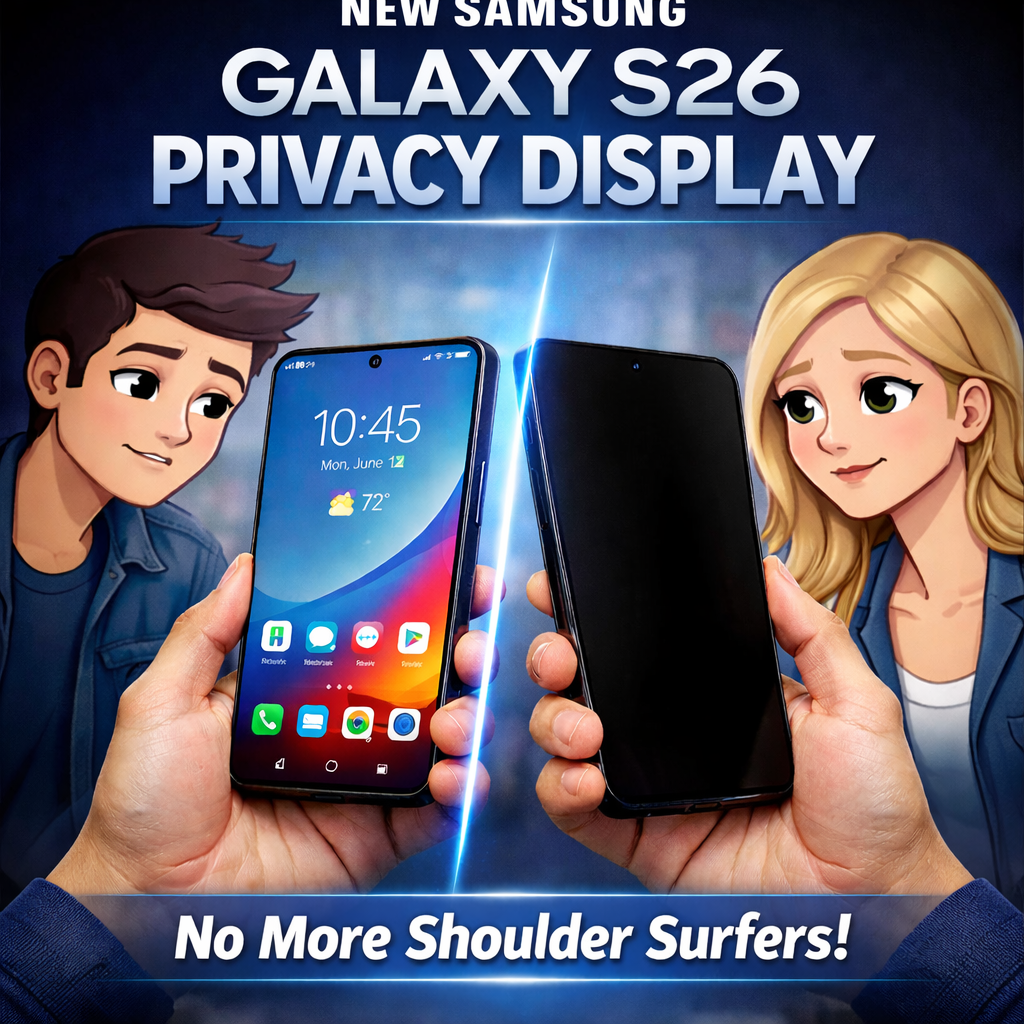
Visual eavesdropping on mobile screens has become an everyday concern for smartphone owners. Whether texting on a crowded subway, entering authentication codes in a cafe, or reviewing confidential work documents in an open office, nearby individuals can easily glance at sensitive information. Samsung development of integrated Privacy Display technology for the upcoming Galaxy S26 lineup addresses this issue directly at the hardware engineering level.
Unlike traditional add-on screen filters that permanently compromise display quality, Samsung engineering approach integrates active privacy controls directly into the OLED display panel stack. This innovation provides dynamic on-demand privacy protection without requiring bulky aftermarket accessories.
The Limitations of Traditional Privacy Screen Protectors
For years, smartphone users seeking visual confidentiality relied on adhesive plastic or tempered glass privacy screen protectors. These accessories use micro-louver technology, functioning like miniature vertical window blinds laminated directly over the display glass. While they block side-angle viewing to some degree, they introduce severe compromises that degrade the mobile experience every single day:
- Permanent Brightness Loss: Traditional privacy films cut overall optical transmission by thirty to forty percent, forcing users to push their display brightness higher and accelerating battery drain.
- Degraded Color Accuracy and Graininess: Static physical louvers introduce color shifting, visible grid lines, and noticeable optical grain, diminishing the clarity of high-resolution OLED panels.
- Inflexible Operation: An adhesive privacy protector is permanent until physically peeled off. When sharing a video or photo with a friend sitting beside you, the privacy filter blocks their view entirely.
- Touch and Fingerprint Recognition Friction: Thick plastic layers often interfere with ultrasonic in-display fingerprint scanners, slowing down device unlocking times.
How the Galaxy S26 Privacy Display Operates
Samsung new Privacy Display technology, developed under the Flex Magic Pixel engineering framework, solves these compromises by embedding active directional light control directly into the sub-element architecture of the OLED panel. Rather than relying on a passive plastic film, the panel incorporates electrically switchable liquid crystal or polarizing layers within the glass substrate.
When the privacy feature is inactive, the OLED sub-elements emit light across standard wide viewing angles, providing rich colors, broad off-axis visibility, and full peak brightness for multimedia enjoyment. When the privacy mode is activated, an electrical charge aligns microscopic light-directing structures in front of each sub-element. This collimates the emitted light into a narrow forward-facing cone centered directly on the user eyes.
Anyone viewing the phone from an angle of thirty degrees or wider sees an opaque, blackened screen surface. To the user looking straight at the phone, the display remains clear, sharp, and color-accurate, preserving the visual fidelity of the primary display panel.
Intelligent Software Automation and Localized Privacy Zones
The true power of Samsung implementation lies in how deep hardware integration connects with system software in One UI. Because the light-directing layer is controlled electronically, the system can automate privacy enforcement based on real-time contexts:
1. Application-Specific Activation
Users can configure the privacy mode to engage automatically whenever designated sensitive applications launch. Opening a mobile banking portal, password manager, cryptocurrency wallet, or enterprise corporate email client immediately narrows the viewing angle. Returning to the home screen or opening a photo gallery automatically restores wide viewing angles.
2. Localized On-Screen Privacy Windows
Because the hardware addresses display areas individually, the system can apply privacy filters to specific rectangular screen regions rather than blacking out the entire display. When an incoming text notification banner drops down from the status bar, the privacy filter can activate specifically over that preview bubble, preventing adjacent observers from reading the message content while the rest of the display remains fully visible.
3. Sensor-Assisted Proximity Awareness
Working in coordination with the front-facing camera and infrared proximity sensors, the device can detect secondary faces appearing within the field of view over the user shoulder. If the sensor identifies an observer leaning in from the side, the system can flash a discreet security warning and instantaneously engage narrow-angle mode to safeguard active content.
4. Quick Settings and Gesture Integration
For immediate manual control, Samsung incorporates a dedicated Privacy Display tile within the Android quick settings shade. Users can pull down the notifications panel with a single swipe and toggle the narrow viewing angle on or off in a fraction of a second. Additionally, advanced gesture shortcuts, such as a double-tap on the back panel or a simultaneous squeeze of the side keys, can trigger instant visual cloaking when entering crowded elevators or boarding packed public transportation.
Technical Comparison: Hardware Privacy vs Adhesive Protectors
| Evaluation Metric | Traditional Adhesive Privacy Screen | Samsung Active Privacy Display |
|---|---|---|
| Viewing Control | Fixed and permanent | Dynamic on/off software toggle with automated triggers |
| Direct Optical Clarity | Muted colors, noticeable grain, reduced brightness | Full OLED resolution, color calibration, and peak luminance |
| Selective Protection | Whole screen only | Capable of localized masking for notifications and input fields |
| Biometric Unlocking | Interferes with ultrasonic fingerprint sensors | Zero impact on ultrasonic fingerprint scanning accuracy |
| Content Sharing | Impossible to share screen with peers beside you | Easily disabled in quick settings to share videos with friends |
| Installation Friction | Air bubbles, dust trapping, edge peeling | Integrated factory hardware with no physical application |
Practical Everyday Use Cases
Integrating active hardware privacy into the Galaxy S26 lineup provides tangible security improvements across a variety of daily environments:
- Urban Commuting: Passengers on buses, trains, and flights can review personal messages and financial accounts without worrying about curious seat neighbors.
- Corporate Workspaces: Enterprise employees handling confidential client data, spreadsheets, and proprietary communications can operate securely in open-plan offices and shared co-working desks.
- Financial Transactions: Entering debit card PINs, banking credentials, and two-factor authentication tokens in checkout lines remains shielded from casual glance theft.
- Discreet Public Communication: Responding to sensitive medical or family conversations in waiting rooms and elevators remains private without requiring users to tilt the phone away awkwardly.
- Document Review: Legal and healthcare professionals can inspect patient records or legal contracts while traveling without risking unintentional confidentiality disclosures.
Power Consumption and Durability Considerations
Hardware modifications inside a display stack naturally raise questions regarding battery efficiency and hardware longevity. Samsung engineered the active privacy layer using low-voltage switching circuits that require minimal continuous current once the liquid crystal molecules align. Because the system does not require users to artificially hike backlight brightness to compensate for a dark plastic filter, everyday power consumption remains balanced.
Furthermore, because the privacy elements sit sealed beneath the reinforced outer cover glass, the mechanism is immune to the scratches, edge chipping, and corner lifting that plague adhesive films. The screen maintains its native oleophobic coating, ensuring smooth touch gestures and effortless cleaning over the lifespan of the device.
Summary of the Technology
The Samsung Galaxy S26 Privacy Display represents a practical hardware advancement in mobile security. By integrating electronically controlled directional optics directly into the OLED panel, the technology eliminates the optical degradation and permanent dimming associated with adhesive plastic protectors. The combination of dynamic on-demand activation, localized screen masking, and automated app-level privacy rules delivers robust protection for confidential communications while preserving the visual brilliance of modern display technology.