
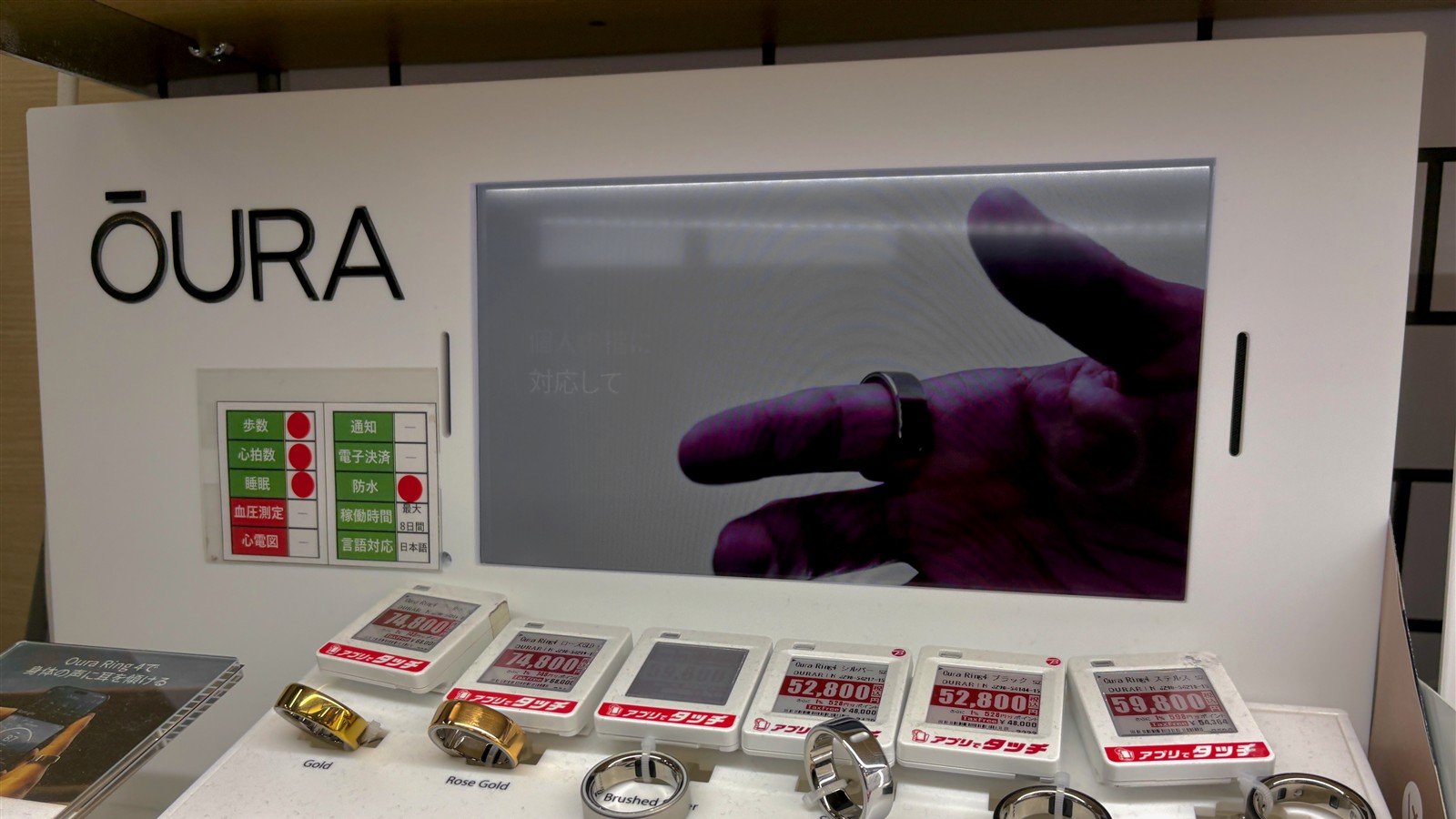
This Oura Ring 5 review takes a close look at the newest Oura smart ring, including every important published specification, the useful features, the frustrating limitations and the real cost of owning one.
Affiliate disclosure: This article may contain an Amazon affiliate link. If you buy through it, I may earn a commission at no extra cost to you. This does not affect the verdict or the points raised in this review.
The Oura Ring 5 arrived in June 2026 with an unusually simple sales pitch: make the best-known smart ring much smaller without sacrificing battery life or health data. That may not sound dramatic, especially when phones and watches are sold on long lists of new functions. On a device designed to remain on your finger all day and all night, however, comfort is not a minor detail. It determines whether the product gathers enough continuous data to be useful or ends up forgotten in a drawer.
Oura has reduced the Ring 5 to 6.09 mm wide and 2.28 mm thick, with a starting weight of only 2 grams. It is 40 percent smaller by volume than the Oura Ring 4, yet the quoted battery life has increased to between six and nine days. The redesigned titanium body also gets a harder surface coating, while the sensors have been rearranged and strengthened.
There is a catch, and it is not a small one. The Oura Ring 5 starts at GBP 399 in the UK, rises to GBP 499 for premium finishes and still needs an Oura Membership if you want detailed data rather than three headline scores. It is an elegant health tracker, but it is priced like a premium watch despite having no screen, no built-in GPS, no notifications and no contactless payment support.
So, is the Oura Ring 5 worth it? For a first-time Oura buyer who values sleep, recovery and comfort, it can be. For an owner of the Ring 4, or a serious athlete wanting live performance data, the case is much weaker.

Oura Ring 5 review: quick verdict
The Oura Ring 5 is the most comfortable and discreet version of Oura’s health tracker so far. Its smaller titanium body matters in daily use, especially during sleep, and its six-to-nine-day battery rating is excellent for something this small. Oura’s app remains the main attraction. It turns heart rate, heart rate variability, temperature, movement, breathing and sleep data into advice that is easier to understand than a wall of raw numbers.
It is not equally strong in every area. Fitness tracking is useful for general activity, but the ring is not a replacement for a proper running watch or cycling computer. It relies on a phone for GPS routes and live pace. The ring itself does not show live heart rate on your phone during an activity unless a compatible third-party heart rate monitor is connected. Weight training can also scratch the finish, affect comfort and create a safety risk if the ring catches on equipment.
The subscription is the biggest objection. Without an active membership, the app is reduced mainly to Sleep, Activity and Readiness scores, battery information, basic settings and limited content. Paying GBP 399 or GBP 499 and then losing most of the detail when the subscription ends feels mean.
Overall verdict: An excellent sleep and recovery tracker in a remarkably small body, but one that asks buyers to accept a high price, a recurring fee and limited sports features.
Oura Ring 5 pros and cons
What is good
- Exceptionally small and light for a full health-tracking ring
- Comfortable enough for continuous daytime and overnight wear
- Detailed sleep, recovery, stress and heart-health insights
- Quoted six-to-nine-day battery life
- Full titanium construction with a harder PVD coating
- 100-metre water resistance and an IP68 rating
- Works with both iPhone and Android phones
- Useful automatic activity detection
- More than 100 supported app integrations
- No screen, vibrations or notifications to distract you
What could be better
- Very expensive, particularly in the premium finishes
- Membership required for nearly all detailed insights
- No built-in GPS
- No screen, alarms, notifications, payments or music controls
- Not ideal for live sports tracking
- Battery is sealed and cannot be replaced
- Only three days of unsynced data storage
- Sizes 4, 5, 14 and 15 are no longer offered
- Different sizing means even existing Oura users need a new sizing kit
- The finish can still scratch despite the tougher coating

Oura Ring 5 specifications
| Specification | Oura Ring 5 details |
|---|---|
| Product type | Screen-free smart health ring |
| Launch date | 4 June 2026 |
| UK price | GBP 399 for Silver and Black; GBP 499 for Gold, Deep Rose, Stealth and Brushed Silver |
| Membership | First month included for new members; ongoing regional monthly or annual fee required for full insights |
| Available finishes | Black, Silver, Stealth, Brushed Silver, Gold and Deep Rose |
| Sizes | Oura sizes 6 to 13, whole sizes only |
| Width | 6.09 mm |
| Thickness | 2.28 mm |
| Volume change | 40 percent less volume than Oura Ring 4 |
| Sensor dome height | 0.7 mm |
| Weight | From 2 grams, depending on size |
| Outer material | High-performance titanium with super-hard physical vapour deposition coating |
| Inner material | Seamless, non-allergenic titanium inner shell with a BPA-free surface |
| Optical system | Two tri-colour LED emitters and two photodetectors |
| LED colours | Red, green and infrared |
| Temperature sensor | Digital sensor for average body-temperature variation and trends |
| Motion sensor | 3D accelerometer for movement and activity tracking |
| Tracked signals | Heart rate, heart rate variability, respiration rate, blood oxygen, temperature trends, sleep and movement |
| Published health coverage | More than 50 health metrics and insights |
| Manufacturer accuracy claims | 99 percent heart-rate correlation against ECG and 95 percent sleep-staging accuracy against a clinical sleep lab; results depend on testing conditions |
| Automatically detected activities | More than 40 supported activity types |
| Built-in GPS | No; route, live distance and pace use the connected phone’s location services |
| Display and controls | No display, button, speaker or vibration motor on the ring |
| Battery type | Rechargeable, sealed and non-replaceable lithium-polymer battery |
| Battery capacity | Approximately 15 mAh in size 6 to 22 mAh in size 13 |
| Rated battery life | Typically six to nine days, depending on size, settings, features, activity, age and use |
| Standard charging time | About 80 minutes, depending on remaining charge |
| Standard charger | Size-specific aluminium charging dock, USB-C powered |
| Optional charging case | Size-specific case, up to five ring charges, wired USB-C or Qi 1.3 charging, sold separately |
| Fast top-up claim | About one day of ring use from ten minutes in the optional charging case |
| Water resistance | 100 metres or 328 feet; suitable for swimming, showers, saunas and water sports, but not diving |
| Ingress rating | IP68 water and dust resistance |
| Operating temperature | Published guidance varies slightly by page, approximately -10 C to 52-54 C; charge at room temperature |
| On-ring data storage | Up to three days before syncing |
| Wireless connection | Bluetooth 5.0 Low Energy |
| Phone requirements | iPhone running iOS 16 or later, or Android 11 or later with Google Play services; phone must support Bluetooth 5.0 |
| Units | Metric and imperial |
| App languages | Arabic, Chinese, Czech, Danish, Dutch, English, Finnish, French, German, Greek, Hebrew, Hindi, Hungarian, Italian, Japanese, Korean, Norwegian, Polish, Portuguese, Spanish and Swedish |
| Third-party integrations | More than 100 apps, including Apple Health, Android Health Connect, Strava and selected women’s-health services |
| Firmware | Automatic updates through the Oura app |
| Airplane mode | Supported |
| Certification | FCC certified |
| SAR level | 0.0003 W/kg according to Oura |
| Medical status | Not a medical device and not intended to diagnose, treat, cure, monitor or prevent illness |
| Intended user | Adults aged 18 and over |
| Box contents | Oura Ring 5, size-specific standard charger, USB-C cable and printed information |
Charger and charging case specifications
| Specification | Included Ring 5 charging dock | Optional Ring 5 charging case |
|---|---|---|
| Ring compatibility | Oura Ring 5 only, matched to sizes 6 to 13 | Oura Ring 5 only, matched to sizes 6 to 13 |
| Colour | Anodised Silver | Anodised Silver |
| Material | Aluminium body | Recycled aluminium body, silicone insert and fully rubberised base |
| Dimensions | Square, 50 x 50 x 1.8 mm as published by Oura | Circular, 55 x 56 x 17 mm |
| Weight | 37 grams | 60 grams |
| Power capacity | No internal battery | Up to five full ring charges, described as up to a month of power on the go |
| Charging input | Wired USB-C | Wired USB-C or Qi 1.3 wireless charging |
| Charging time | About 80 minutes for the ring, depending on battery level | About 80 minutes for a full ring or case charge, depending on battery level |
| Water resistance | No published water resistance | Splash-resistant |
| Wireless connection | None | Bluetooth connection to the phone for battery level and firmware |
| Physical control | None | Side button for charge status, pairing and reset functions |
| Included cable | USB-C to USB-C cable included with the ring | No separate cable included |
Design and comfort
The Ring 5’s most important improvement is visible before the app is even installed. It looks much closer to an ordinary band than earlier smart rings. At 6.09 mm wide, it is 1.81 mm narrower than the Ring 4. Its 2.28 mm thickness is about 0.6 mm slimmer. Those figures appear tiny on a specification sheet, but fingers are sensitive to bulk. A broad ring touches neighbouring fingers, catches on pockets and becomes difficult to ignore when making a fist. Reducing both width and thickness deals with all three problems.
The starting weight of 2 grams is equally impressive. The exact figure changes with ring size, but even the larger versions remain far lighter than a watch. There is no display, button, speaker or vibration motor. That makes the Ring 5 deliberately boring in the best possible way. It collects data without demanding attention.
Oura still uses a small external dimple to show which way the ring should face. The dimple belongs on the palm side of the finger so the sensors remain correctly positioned. Inside, a 0.7 mm sensor dome helps the optical system maintain contact. The dome is slightly taller than the one in the Ring 4, but the narrower body should make the overall fit less intrusive.
The full titanium construction covers both the outside and inside. Oura describes the inner shell as non-allergenic and BPA-free. No wearable can guarantee that every person’s skin will tolerate it, especially when sweat, soap or hand sanitiser remains trapped beneath a tight band. Anyone who notices redness, itching or flaking should remove it, clean and dry both the ring and finger, then allow the skin to recover.

Six finishes, two prices
Silver and Black are the standard GBP 399 options. Gold, Deep Rose, Stealth and Brushed Silver cost GBP 499. The hardware and health features do not improve when you pay the extra GBP 100. You are paying for colour and surface treatment, not better sensors or a larger battery.
All six finishes now use what Oura calls a super-hard PVD coating. It should resist marks better than earlier finishes, but scratch-resistant does not mean scratch-proof. Metal gym equipment, stone worktops, cookware and neighbouring rings can still leave visible damage. Oura itself recommends removing the ring during high-friction activities such as weightlifting. Wear-and-tear scratches are not normally treated as a warranty defect.
Sizing needs care
Oura offers sizes 6 to 13, with no half sizes. These are Oura sizes, not ordinary jewellery measurements. More importantly, Ring 5 sizing differs slightly from Ring 4 sizing. Buying the number printed inside an older Oura ring is therefore a gamble.
Use the Ring 5 sizing kit and wear the chosen sample for a full day and night. Fingers change size with heat, cold, salt intake, exercise and sleep. The ring should remain snug enough for the sensors to stay against the palm side of the finger, but it should not become painful or difficult to remove. Oura recommends the index finger for the strongest signal, although the middle or ring finger can work if the fit is good.
The reduced range is a real backward step for accessibility. Ring 4 buyers could choose sizes 4 to 15. Ring 5 buyers with particularly small or large fingers may be excluded completely.

Sensors and what they measure
The Oura Ring 5 uses two tri-colour LED emitters, two photodetectors, a digital temperature sensor and a 3D accelerometer. That sounds modest next to a feature-heavy smartwatch, but the location helps. Blood vessels in the finger provide a strong optical signal, while the close fit makes temperature trends easier to follow overnight.
Red and infrared light
Red and infrared LEDs are used for overnight blood-oxygen sensing. The app reports average SpO2 and breathing regularity rather than presenting the ring as a medical pulse oximeter. A low or unusual result can be useful as a prompt to pay attention, but it should not be treated as a diagnosis.
Green and infrared light
Green and infrared LEDs alternate to measure heart rate and heart rate variability throughout the day and night. Heart rate variability, or HRV, is the changing time between heartbeats. Oura uses it as one part of its recovery and stress analysis. Higher is not automatically better for every person; the useful comparison is usually against your own established baseline.
The same optical system contributes to respiration-rate estimates and activity heart rate. Oura claims 99 percent heart-rate accuracy when compared with an ECG, expressed as an r-squared correlation figure. That is a manufacturer claim under test conditions, not a promise that every reading during every workout will be 99 percent correct. Motion, fit, skin contact and the type of exercise all matter.
Digital temperature sensing
The ring follows changes in average body temperature rather than replacing a clinical thermometer. Trends can contribute to Readiness, illness warnings, cycle insights and period prediction. The value lies in repeated measurements from the same location under similar overnight conditions. A single variation can be caused by illness, alcohol, room temperature, menstrual-cycle changes, late exercise or several other factors.
3D accelerometer
The accelerometer measures movement in all directions. It supports step counting, inactivity alerts, automatic activity detection and sleep movement. Activities with obvious hand motion are easier to recognise than low-motion exercise such as yoga or strength training. Manual corrections remain useful when the automatic label is wrong.
Sleep tracking
Sleep is where the Ring 5 makes the strongest argument for itself. Watches can collect similar data, but a small ring is generally easier to tolerate in bed. There is no bright screen against the pillow and no heavy watch body pressing into the wrist.
The app combines total sleep, time in bed, sleep efficiency, latency, timing, restfulness, REM sleep and deep sleep into a Sleep Score. It also shows a sleep-stage timeline, resting heart rate, HRV, breathing regularity, blood oxygen, movement and temperature trends. Bedtime guidance suggests when to wind down, while chronotype and body-clock information tries to place sleep within a longer personal pattern.
Oura claims 95 percent sleep-stage accuracy compared with a clinical sleep laboratory. That claim deserves context. Consumer wearables infer sleep stages from indirect signals and are not a replacement for polysomnography. The Ring 5 can be very good at showing consistent trends and identifying obvious changes, but an individual night’s minute-by-minute stage chart should not be treated as unquestionable fact.
Sleep Debt, where available with membership, estimates how much sleep may be missing compared with the user’s personal need over the previous two weeks. Naps can be detected and added to the daily picture. These features are more useful than chasing a perfect score because they encourage attention to patterns rather than one unusually good or bad night.

Readiness, stress and recovery
Readiness is Oura’s attempt to answer a practical question: should you push hard today or take it easier? The score uses recent sleep, resting heart rate, HRV balance, temperature trends, activity and recovery time. It is not a command. It is a summary of how the measured signals compare with your normal range.
Daytime Stress looks for physiological signs of stress while you are awake. It can label periods as stressed, engaged, relaxed or restored. The feature cannot know whether the cause is a difficult meeting, a hard workout, excitement, caffeine or illness. Tags and context matter. Used sensibly, the graph can reveal that a habit consistently coincides with a stronger stress response. Used badly, it can create another reason to worry.
Resilience takes a longer view by combining daytime stress, restorative time and recovery across days. Cumulative Stress and longer-term reports do something similar over wider periods. These tools become more useful after the ring has collected enough continuous data. They are less convincing during the first few days, when the app is still learning a baseline.
Illness Detection, also described in parts of Oura’s software as a symptom or health radar, watches for meaningful shifts in temperature, breathing and cardiovascular signals. An alert means the pattern has changed, not that a particular disease has been found. That distinction is important.
Heart and breathing features
Twenty-four-hour heart-rate tracking shows daytime, nighttime and activity readings. Resting heart rate and HRV are especially helpful overnight, when movement is limited. The app can connect changes with sleep, meals, stress, alcohol, training and other tagged events.
Cardiovascular Age estimates how the user’s cardiovascular system compares with their chronological age. Cardio Capacity provides a VO2 max estimate, which is intended to represent how effectively the body can use oxygen during demanding exercise. The initial VO2 max figure can be based partly on profile details and population averages. A walking test can refine it, but this is still an estimate rather than a laboratory measurement.
Respiration rate is recorded through the optical system, and overnight SpO2 contributes to breathing-regularity information. The Ring 5 is not designed to diagnose sleep apnoea or replace clinical monitoring. Anyone with symptoms or repeated worrying readings should speak to a qualified medical professional.
Activity and fitness tracking
The Oura Ring 5 is a health and recovery tracker first and a sports device second. It counts steps, estimates active and total calorie burn, detects inactivity and can recognise more than 40 activities. The daily Activity Score considers movement, training frequency, recovery and consistency. Goals can change according to Readiness, which is more thoughtful than demanding the same target after poor sleep or illness.
Automatic Activity Detection can recognise common movement without requiring a workout to be started manually. It is convenient for walks, cycling, housework and casual exercise. The app will normally ask the user to confirm or correct a detected session. That small bit of housekeeping improves later trends.
The limitations appear during structured training. There is no built-in GPS. Outdoor routes, pace and distance rely on the phone’s location services, so the phone needs to be carried with the app running in the background. The ring records activity heart rate, but it does not stream its own live heart rate to the phone screen. Live heart rate in the Oura app requires a compatible third-party monitor. Without one, the ring’s heart-rate graph appears after the activity.
There is also no screen for lap times, zones, pace, navigation or workout prompts. Runners, cyclists and serious gym users will probably want another device for training. The Ring 5 can still provide useful sleep and recovery context alongside it.
Strength training deserves a separate warning. Gripping a bar or dumbbell with a rigid titanium ring can be uncomfortable, scratch the finish and create a risk if the ring catches. Removing it for lifting is sensible, even though doing so creates a gap in movement data.
Women’s health and metabolic features
Temperature trends support Cycle Insights, period prediction and pregnancy-related insights. Oura can also connect with selected services such as Natural Cycles, Flo and Clue, although availability and requirements differ. Fertility or contraception decisions should follow the instructions and regulatory status of the connected service, not a casual reading of the Oura temperature graph.
The software also includes meal logging and selected metabolic-health integrations. Glucose information depends on a compatible external service or sensor; the Ring 5 does not contain a glucose sensor. Likewise, GLP-1 medication tracking and related insights are software features, not measurements of medication levels.
Oura app, Advisor and integrations
The app is where raw sensor readings become a coherent product. Three scores – Sleep, Activity and Readiness – sit at the centre. Detailed pages explain which contributors helped or hurt each score. Weekly, monthly, quarterly, yearly and anniversary reports make it easier to notice gradual changes.
Oura Advisor adds conversational guidance based on the user’s data and stated goals. It can be useful for finding a pattern without digging through several charts. It can also produce advice that feels more certain than the underlying data deserves. It should be treated as a navigation and reflection tool, not a doctor or a substitute for professional judgement.
The app supports iOS 16 or later and Android 11 or later with Google Play services. The phone must support Bluetooth 5.0. This excludes Android devices without Google Play services and older phones that might otherwise work perfectly well.
Oura says it works with more than 100 apps. Major routes include Apple Health on iPhone, Health Connect on Android and Strava. The exact data that moves in each direction varies. Apple Watch users can also view Oura information through a companion app, but the ring is still managed through the phone.
The list of app languages is broad: Arabic, Chinese in traditional and simplified forms, Czech, Danish, Dutch, English, Finnish, French, German, Greek, Hebrew, Hindi, Hungarian, Italian, Japanese, Korean, Norwegian, Polish, Portuguese, Spanish and Swedish. Metric and imperial measurements are both supported.
Battery life and charging
Oura rates the Ring 5 for six to nine days. Ring size matters because the internal cell ranges from about 15 mAh in size 6 to 22 mAh in size 13. Enabled features, app settings, activity tracking, battery age and temperature also affect endurance. A larger ring does not guarantee the top figure in every situation, but it has room for more capacity.
A full charge takes about 80 minutes. The included aluminium dock is specific to the ring size, so a size 9 ring needs a size 9 charger. This is easy to overlook when replacing a charger or sharing accessories. The box includes the dock and a USB-C cable, but not necessarily a wall plug.
The optional Ring 5 charging case is sold separately for around GBP 99. It holds up to five full ring charges and can itself charge through USB-C or a compatible Qi 1.3 pad. Oura claims ten minutes in the case can add roughly a day of ring use. The case is also size-specific and is not a cheap accessory, but frequent travellers may find it more useful than the standard dock.
The weakest battery specification is long-term repairability. The lithium-polymer cell is sealed and non-replaceable. Every rechargeable battery loses capacity with age and charge cycles. When endurance becomes unacceptable, there is no official battery swap that restores the ring. That is difficult to defend in a product costing up to GBP 499.
On-ring storage has also fallen from seven days in the Ring 4 to three days in the Ring 5. Daily syncing is the safest habit. A weekend away from the phone should be fine; a longer disconnected trip could risk losing older data.
Water resistance, durability and safety
The Ring 5 carries an IP68 rating and a 100-metre water-resistance claim. It can be worn while washing hands, showering, swimming, using a hot tub, entering a sauna or taking part in ordinary water sports. Oura specifically says it is not suitable for diving. Water resistance can also decline after physical damage, so a cracked or distorted ring should not be trusted merely because it was rated at the factory.
Published operating-temperature guidance is slightly inconsistent: Oura’s Ring 5 page lists -10 C to 54 C, while its general safety page lists -10 C to 52 C. The practical advice is the same. Normal daily temperatures are fine, charging should happen at room temperature and prolonged exposure below -20 C or above 60 C may damage the battery.
The ring uses Bluetooth 5.0 Low Energy. Oura states that Bluetooth is active for well below one percent of a normal day outside syncing and updates. Its quoted specific absorption rate is 0.0003 W/kg. Airplane mode can stop wireless communication until the ring is placed on its charger again.
Oura describes the product as intended for adults aged 18 and over. It is not a medical device. The rigid titanium band should be kept away from young children, and anyone with severe finger swelling or a ring that cannot be removed should seek medical help rather than forcing it.
Oura Membership: the cost after purchase
New members receive one complimentary month. After that, full access needs a paid monthly or annual membership at the price shown for the account’s region. UK pricing has commonly been listed at GBP 5.99 per month or GBP 69.99 per year, but buyers should confirm the current amount before ordering because regional pricing and tax can change.
Without membership, the ring does not become completely useless. The app continues to show the three daily Sleep, Activity and Readiness scores, ring battery, basic profile details, settings and selected Explore content. The detailed contributors, trends, guidance and most of the reason to buy an Oura ring are restricted.
Over three years, an annual membership at GBP 69.99 adds about GBP 210 to the purchase. That makes the effective cost roughly GBP 609 for a standard finish or GBP 709 for a premium finish, before accessories. This is the number that should guide the value decision, not the box price alone.
Oura Ring 5 vs Oura Ring 4
| Feature | Oura Ring 5 | Oura Ring 4 |
|---|---|---|
| Width | 6.09 mm | 7.9 mm |
| Thickness | 2.28 mm | About 2.88 mm |
| Starting weight | From 2 grams | From about 3.3 grams |
| Volume | 40 percent smaller | Larger baseline design |
| Photodetectors | Two | Three |
| LED emitters | Two tri-colour units | Two tri-colour units |
| Rated battery | Six to nine days | Five to eight days |
| Offline storage | Up to three days | Up to seven days |
| Sizes | 6 to 13 | 4 to 15 |
| Materials | Titanium inside and out, super-hard PVD on every finish | Titanium inside and out, finish-dependent PVD or DLC; ceramic models also sold |
| Main software features | Broadly shared with Ring 4 | Broadly shared with Ring 5 |
The Ring 5 wins on comfort, compactness, surface durability and maximum quoted battery life. The Ring 4 wins on size choice, offline storage, lower sale pricing and access to ceramic versions. Most new software is not exclusive to the newer ring, so Ring 4 owners are not missing an entirely different app experience.
For someone who finds the Ring 4 bulky, the Ring 5’s physical redesign can justify upgrading. If the Ring 4 already feels comfortable and its battery remains healthy, paying again for largely the same health features is difficult to recommend.
Who should buy the Oura Ring 5?
- People who care most about sleep and recovery: The small body and mature app make this its strongest use.
- Anyone who dislikes sleeping in a watch: A 2-gram ring is far less intrusive than most wrist wearables.
- First-time Oura buyers wanting the smallest model: The Ring 5 is the cleanest entry point if the price is acceptable.
- Ring 3 or older owners: The comfort, sensing platform and software represent a more meaningful generational jump.
- People who want health data without notifications: There is no screen or vibration to interrupt the day.
Who should not buy it?
- Happy Ring 4 owners: The same core software and similar health data make the upgrade poor value unless size is a problem.
- Serious runners, cyclists and gym users: No built-in GPS, no screen and limited live metrics mean another training device is likely.
- Anyone opposed to subscriptions: The free mode removes most of the detail that makes Oura useful.
- Buyers outside sizes 6 to 13: There is no suitable Ring 5 size.
- People expecting medical diagnosis: The ring can highlight trends, but it is not a medical device.
- Long-term repairability buyers: The sealed battery cannot be replaced.
Price and value
At GBP 399, the Silver and Black models are expensive but at least avoid the cosmetic surcharge. At GBP 499, the premium finishes are hard to justify unless appearance is central to the purchase. Nothing in the sensor package, battery rating or app improves with the dearer colour.
The Oura Ring 5 earns part of its price through miniaturisation. Fitting continuous optical sensing, temperature measurement, motion tracking, Bluetooth and nearly a week of power into a 2-gram titanium ring is impressive engineering. The app is polished, the explanations are approachable and the device is easier to wear consistently than its predecessor.
Value still falls apart for buyers who will resent the membership. A premium health product should reveal the data it has already collected without requiring an indefinite fee. Oura is selling a hardware-and-service package, and the total cost needs to be judged that way.
If buying through Amazon, check that the listing is sold by Oura or a clearly authorised retailer, choose the correct generation of sizing kit and confirm that the selected finish and size match. Ring listings contain many near-identical variants, so it is easy to order the wrong one.
Final verdict: is the Oura Ring 5 worth it?
The Oura Ring 5 succeeds at the one improvement that matters most for a smart ring: it becomes easier to forget that it is there. The narrower, thinner and lighter titanium body is not a cosmetic refresh. It directly improves the chance that the ring will remain on the finger through work, rest and sleep, which is how it builds useful trends.
Its sleep, recovery, stress and heart-health presentation is excellent. Battery life is strong, water resistance is reassuring and the lack of a screen keeps the product calm and unobtrusive. For a new buyer who wants a premium wellness tracker rather than a sports watch, it is one of the most convincing options of its kind.
The weaknesses are just as clear. It is expensive, the premium colours cost too much, the subscription locks away most detailed information and the non-replaceable battery limits its useful life. Fitness tracking remains secondary, offline storage has been cut and the smaller size range leaves some buyers behind. Ring 4 owners receive too little new functionality to make this an automatic upgrade.
Buy it if: comfort, sleep and recovery matter more to you than live workout data, and you accept the ongoing membership.
Skip it if: you already own a comfortable Ring 4, want a subscription-free product or need a full sports tracker.
Buy Here on Amazon