Introduction
According to XREAL, the glasses use Sony micro OLED panels, run at up to 120 Hz, and display Full HD 1920 × 1080 images per eye.
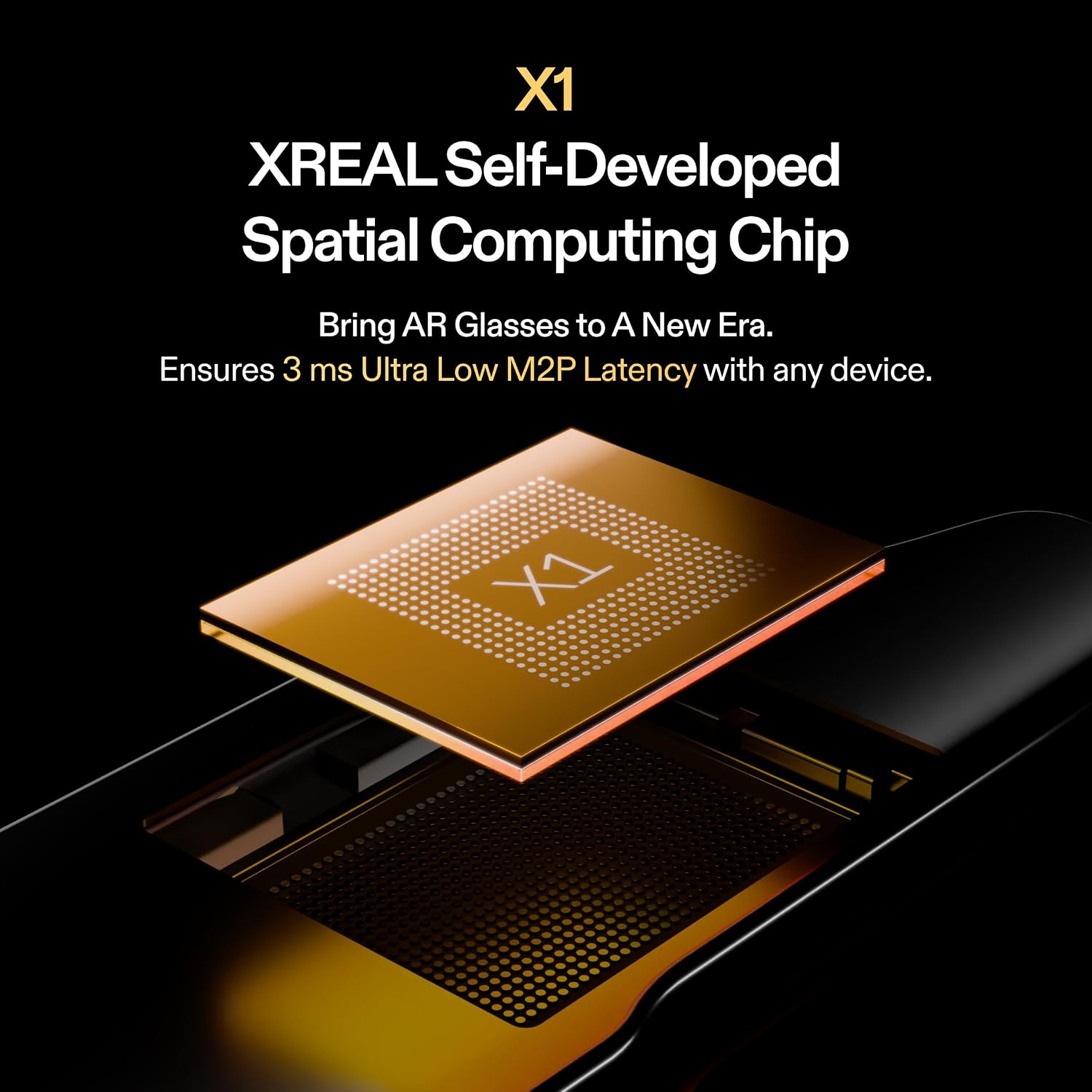
They also feature the company’s custom X1 spatial chip that provides three degree of freedom head tracking.
Independent reviews confirm these specs and note a weight of about 84 grams, a 50 degree field of view, and roughly 600 nits of perceived brightness.
This review checks how well those numbers translate into real world performance and whether the XREAL One truly lives up to the hype.
Quick Specs (Verified)
| Feature | Confirmed Detail |
|---|---|
| Display | Sony micro OLED (0.68 inch panels) |
| Resolution | 1920 × 1080 per eye (Full HD) |
| Refresh Rate | Up to 120 Hz |
| Field of View | Around 50 degrees diagonal |
| Brightness | 600 nits perceived brightness (manufacturer claim) |
| Tracking | Native 3 DoF rotation tracking via X1 spatial chip |
| Audio | Dual open air speakers, marketed as Sound by Bose |
| Weight | About 84 grams |
| Connectivity | USB-C tethered for video and power, no built in battery |
| Launch Price | 499 US dollars, or about 449 pounds in the UK |
Who the XREAL One is for
The XREAL One is aimed at users who want a lightweight, personal big screen experience without carrying bulky hardware.
It suits three main groups.
Travellers and commuters who watch films or work privately in small spaces.
Gamers using handheld consoles or gaming laptops who need a fast, stable display.
Remote workers and digital nomads who benefit from a large virtual workspace on the go.
It is less suitable for those seeking completely wireless AR or full six degree positional tracking, which this model does not natively provide.
Instead, it focuses on portability, image quality and ease of use.
Design and Build Quality
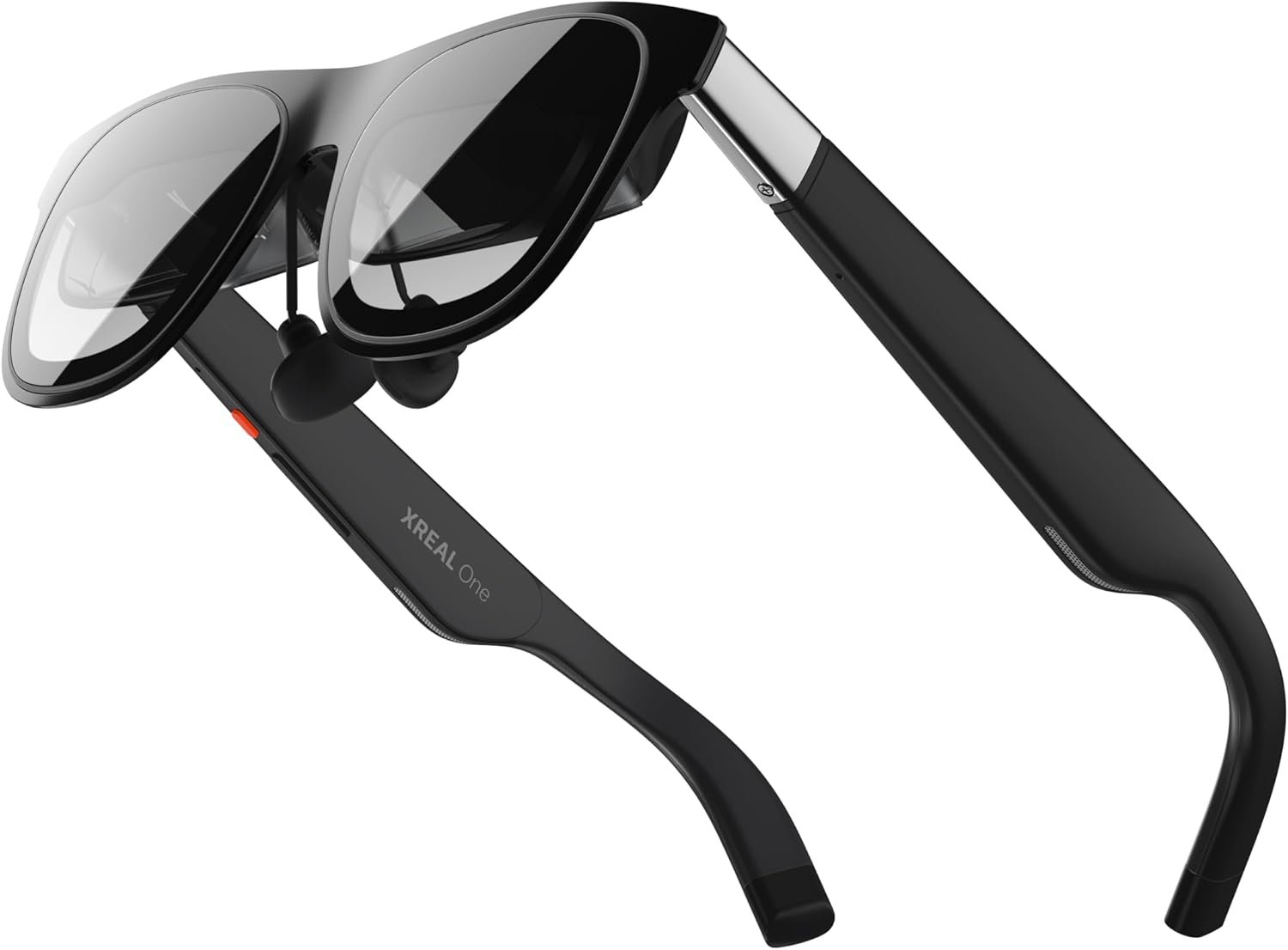
At roughly eighty four grams, the XREAL One is light and balanced enough for long sessions.
It uses a matte finish frame that resists fingerprints and includes adjustable nose pads and temple arms for a secure fit.
Independent reviews report that it feels comfortable to wear for several hours.
A key feature is the electrochromic lens system.
This lets you switch between transparent, shaded and opaque modes, adapting to ambient light.
It also improves privacy and image contrast in bright settings.
The system is confirmed by the manufacturer and functions through a small electronic tint adjustment in the lenses.

Because the device draws power through its USB-C tether, there is no internal battery.
This design keeps the weight low and prevents heat build up, but it does tie you to your source device.
The thin cable is flexible and unobtrusive, allowing enough movement for watching, typing or gaming comfortably.
The overall design feels polished and more like a pair of glasses than a headset, a major advantage for portability and discretion.
Display and Visual Performance
The verified display specification of 1920 × 1080 per eye with Sony micro OLED panels produces clear, bright imagery with deep blacks and excellent contrast.
The OLED technology allows each pixel to switch off completely, so black scenes appear truly dark and colours look vibrant.
The 120 Hz refresh rate keeps fast motion smooth, which helps both video playback and gaming.
Users in independent tests reported very little motion blur.
Brightness is rated at about 600 nits of perceived luminance.
This figure is based on manufacturer data rather than a lab measurement but aligns with reviewer observations that the image remains visible in bright indoor settings.
The 50 degree field of view gives a large, cinematic frame while still allowing awareness of the real world.
At the manufacturer’s default virtual distance, the image looks like a 140 to 150 inch screen floating a few metres ahead.
Text and graphics are sharp enough for writing, editing and general computer tasks, though this depends on your device’s resolution scaling.
As long as your source outputs a Full HD signal, you can comfortably read documents or browse the web.

Tracking and Stability
The X1 spatial chip is the brain behind the tracking system.
It processes head rotation data to stabilise the virtual image using native three degree of freedom tracking.
When you move your head side to side or up and down, the display appears anchored in space rather than drifting with your movement.
This makes watching films or working far more natural compared with earlier AR glasses that lacked proper stabilisation.
Manufacturers and reviewers both note that motion feels smooth and the latency is low enough to avoid discomfort.
However, it is important to understand that this is rotation tracking only.
Full positional tracking, known as six degrees of freedom, is available only if you add compatible external sensors.
The XREAL One on its own does not detect forward, backward or sideways movement in three dimensional space.
In practice, this limitation is not an issue for most use cases such as media playback or desktop work, where users remain seated.
The anchored display still gives a convincing sense of a stable virtual screen.

This post contains affiliate links. If you click a link and make a purchase, I may earn a small commission at no extra cost to you.
Audio Quality
The XREAL One features dual open air speakers positioned just above the ears.
The company promotes this as Sound by Bose, a marketing partnership rather than a confirmed Bose engineered system.
Audio quality is clear and sufficiently loud for private listening without the need for headphones.
The open design keeps you aware of your surroundings, which is safer in public spaces, but it also means limited bass response and some sound leakage.
For casual media, video calls or streaming, the built in audio is convenient.
For immersive gaming or music, connecting dedicated earphones through your host device still provides better fidelity.
Overall, sound performance matches what you would expect from compact open speakers, practical and clear but not audiophile grade.
Connectivity and Compatibility
Connection is handled through a single USB-C port that transmits both power and video.
The glasses act as a plug and play external display for compatible devices.
Most recent laptops, handheld gaming PCs and some Android phones that support DisplayPort Alt Mode will work immediately.
However, compatibility is not universal.
Many phones, especially budget or mid range models, lack the ability to output video over USB-C.
Users must confirm that their device supports DisplayPort before buying.
Since the glasses rely on the host for power, long sessions can drain your battery faster.
A powered hub or power bank can help when travelling or gaming for hours.
Once connected, the glasses appear as a standard external monitor, allowing you to mirror or extend your desktop easily.
Optional companion software offers more advanced features like anchored screen placement and virtual workspace modes, but it is not required for basic operation.
Real World Use and Applications
Streaming and Movies
The XREAL One is ideal for watching films privately during flights or commutes.
The micro OLED image looks vivid, and the anchored screen feels like watching a cinema screen in a dark room.
The electrochromic dimming enhances contrast and immersion even in bright environments.
Gaming
Gamers benefit from the fast refresh rate and low latency.
Whether connected to a gaming laptop, a handheld PC or a console via adapter, the image stays stable and responsive.
The 3 DoF tracking keeps the display fixed, which helps avoid the motion sickness that plagued earlier glasses.
Productivity
For remote work, the XREAL One can replace a physical monitor.
Users can open multiple windows on a large virtual desktop while still seeing their surroundings.
Text remains legible thanks to the Full HD resolution per eye.
This setup works well for editing, writing and multitasking when travelling.
Privacy and Portability
Because the screen is visible only to the wearer, it provides privacy when viewing confidential files or working in public.
The device folds into a compact case that fits into a small bag, making it far easier to carry than a monitor or headset.
Pros
- Verified Full HD micro OLED visuals with deep contrast and rich colour
- Smooth 120 Hz refresh for fluid gaming and video playback
- Native 3 DoF tracking via X1 spatial chip for a stable anchored screen
- Lightweight and comfortable at about 84 grams
- Electrochromic lenses that adjust light transmission
- Convenient open air speakers with clear voice quality
- Plug and play setup on compatible USB-C devices
Cons
- Requires a USB-C connection for video and power, not wireless
- Host device must support DisplayPort Alt Mode to work
- Three degree tracking only, no native positional capability
- Bass response limited on built in speakers
- Brightness and field of view lower than top VR headsets
Pricing and Availability
At the time of writing, the XREAL One is priced at about $499 US dollars
Pricing may vary with taxes and retailers, but the figure remains close across major markets.
The box includes the glasses, cable, case, lens cover and nose pads.
Optional prescription lens adapters and power hubs are available separately.
As of late 2025 the model remains in production and available through official XREAL stores and major online retailers.
Buyers should verify device compatibility before purchase to ensure their phone or computer supports USB-C DisplayPort output.
Final Verdict
After verifying specifications and comparing independent reviews, the XREAL One delivers exactly what it promises, a high quality portable display for media, gaming and work.
The combination of Full HD micro OLED panels, 120 Hz refresh and native 3 DoF tracking makes it one of the most refined wearable screens available today.
It excels at providing a large, private, cinema style view anywhere you can connect a USB-C cable.
However, it remains a tethered device without true 6 DoF or built in power, so it is not a fully independent AR system.
The audio is convenient but limited, and brightness is good rather than exceptional.
These trade offs are acceptable for most users considering its weight, portability and clarity.
For travellers, remote workers and portable gamers who want a private screen that feels like a cinema display in your bag, the XREAL One is an excellent choice and one of the best executions of this technology so far.
Buy Now on Amazon
Click below to check the latest price and get fast delivery from Amazon.
This post contains affiliate links. If you click on a link and make a purchase, I may earn a small commission at no extra cost to you. This helps support the blog and allows me to continue providing content. Thank you for your support!