

This post may contain affiliate links. If you buy something through one of these links, Tech Info Central may earn a small commission at no extra cost to you.
An OPPO K13 Turbo review naturally focuses on gaming because that is how OPPO positions the phone. The hardware supports the claim: a MediaTek Dimensity 8450 platform, 120Hz display, large 7,000mAh battery and fast charging make it far more performance-focused than a typical mid-range handset.
The more interesting question is whether those features also make it a good everyday phone.
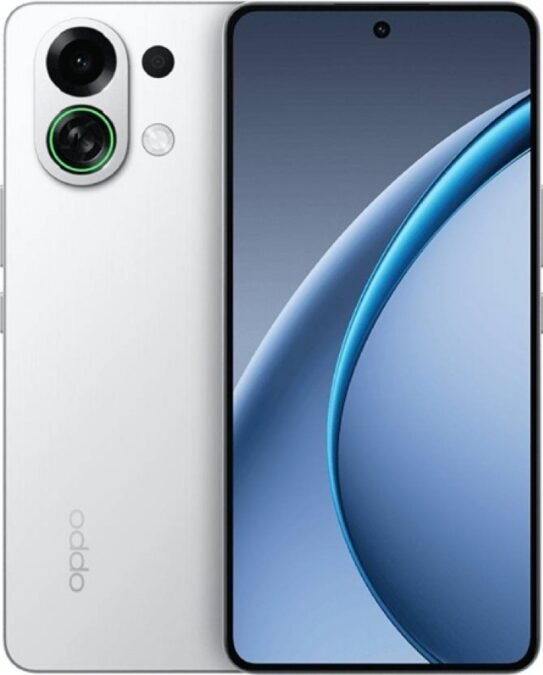
Performance
The standard K13 Turbo uses MediaTek’s Dimensity 8450, paired with LPDDR5X memory and UFS 3.1 storage on supported configurations.
That gives the phone strong application loading and gaming performance without entering ultra-premium pricing.
The chip is only part of the equation. Sustained gaming requires heat management, because a fast processor that throttles after ten minutes is less useful than a slightly slower one that stays consistent.
OPPO therefore places unusual emphasis on cooling in the K13 Turbo range.
Display
The phone uses a 120Hz FHD+ display with a resolution of 2800 x 1280 pixels.
High refresh rates matter most in responsive games and general scrolling. They do not make every title run at 120 frames per second, because the game itself and processor still determine frame rate.
For media, the large screen also makes the K13 Turbo suitable for films and streaming, although buyers should check colour calibration and outdoor brightness rather than looking only at refresh rate.
The 7,000mAh Battery
Battery capacity is arguably the most important specification.
At 7,000mAh, the K13 Turbo carries substantially more capacity than a typical slim flagship. That extra headroom is useful for gaming because demanding titles can drain smaller phones quickly.
OPPO supports up to 80W SuperVOOC charging, helping offset the longer time required to fill such a large battery.
Gaming Focus
A gaming phone needs more than a quick processor. Touch response, thermal consistency, network reliability and software optimisation all affect the experience.
The K13 Turbo’s hardware is clearly designed around sustained use, but prospective buyers should still check support for their favourite games. Some titles cap frame rates regardless of how capable the phone is.
Cameras
Performance-focused phones often spend less of the budget on cameras than photography-led flagships.
That does not mean the K13 Turbo takes bad photographs. It means the camera system should be considered secondary to the processor, cooling and battery.
If long-range zoom, advanced video or the most natural low-light photography is your priority, a more camera-focused phone will make more sense.
Who Should Buy It?
The K13 Turbo is aimed at:
- mobile gamers
- heavy users who value battery life
- people who watch a lot of video
- buyers who want strong performance without flagship pricing
Pros
- Dimensity 8450 performance
- Large 7,000mAh battery
- 80W charging
- 120Hz display
- Fast memory and storage options
- Cooling-focused design
Cons
- Large battery can add weight
- Camera system is not the main priority
- No microSD expansion
- Gaming performance still varies by title
Final Verdict
The OPPO K13 Turbo succeeds because its gaming features also solve normal smartphone problems.
A large battery is useful whether you are playing a game or navigating all day. Fast storage makes every app feel better. Effective cooling helps with sustained workloads beyond gaming.
Buy it for performance and endurance. If photography is your top priority, compare it with camera-focused rivals before committing.