
This post may contain affiliate links. If you buy something through one of these links, Tech Info Central may earn a small commission at no extra cost to you.
Nintendo Switch 2 review buyers in 2026 have an advantage that launch-day customers did not: there is now enough real software and ownership experience to judge the console as a platform rather than a promise.
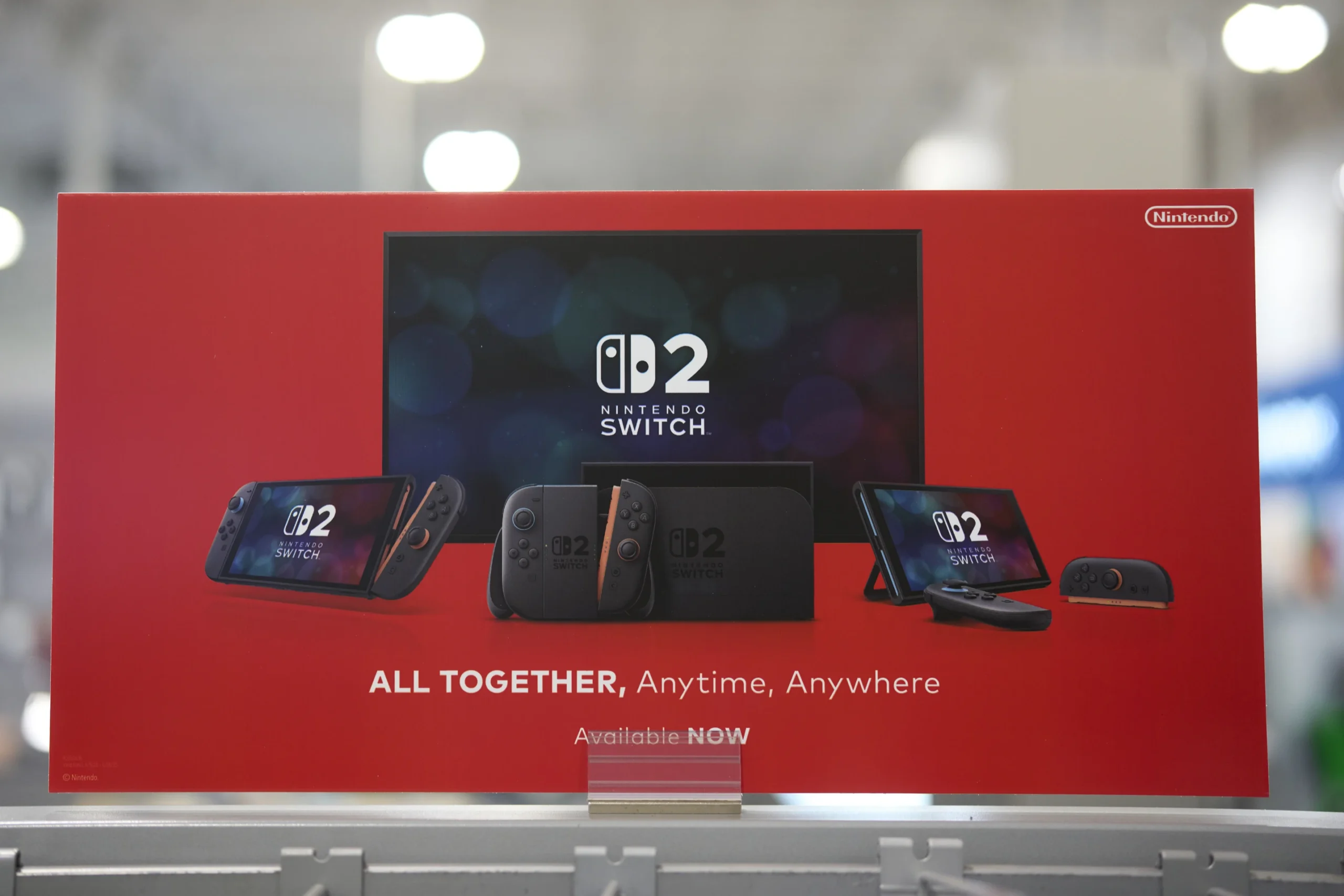
Nintendo kept the original Switch idea intact.
You still have one system that works as a handheld, tabletop console and television console. The difference is that almost every part of the hardware has been modernised.
The Switch 2 is larger, substantially more powerful, faster to navigate and better equipped for demanding games.
It is also more expensive, heavier and still uses an LCD rather than OLED display technology.

Nintendo Switch 2 Key Specifications
| Feature | Nintendo Switch 2 |
|---|---|
| Display | 7.9-inch LCD |
| Handheld resolution | 1920 x 1080 |
| Refresh rate | VRR up to 120Hz |
| HDR | HDR10 |
| Processor | Custom NVIDIA processor |
| Internal storage | 256GB UFS |
| Expandable storage | microSD Express |
| TV output | Up to 4K at 60fps |
| High-frame-rate output | Up to 120fps at 1080p or 1440p |
| Wireless | Wi-Fi 6 and Bluetooth |
| Battery | 5,220mAh |
| Claimed battery life | Roughly 2 to 6.5 hours depending on use |
The Screen Is a Major Upgrade
The 7.9-inch 1080p display immediately makes the Switch 2 feel more modern than the original Switch.
Text is sharper, games have more room to breathe and the larger panel suits games with dense interfaces.
VRR support up to 120Hz is particularly useful.
Compatible games can feel much smoother than the old 60Hz limit, while variable refresh can reduce the visual problems caused by uneven frame delivery.
The disappointment is panel technology.
Nintendo chose LCD rather than OLED.
The display can still look very good, but it cannot reproduce the deep blacks and contrast of the Switch OLED.
Anyone moving directly from an OLED Switch may notice that trade-off even while appreciating the higher resolution and refresh rate.
Performance Is the Real Generational Change
The custom NVIDIA platform gives developers far more room than the original Switch hardware.
That matters because the first Switch spent much of its later life relying on aggressive resolution scaling and substantial graphical compromises in ambitious ports.
Switch 2 does not suddenly compete with a high-end gaming PC.
It does, however, provide a much more capable target for modern games.
Features such as NVIDIA-assisted upscaling can help developers balance image quality and performance, while the stronger CPU and memory subsystem make more complex game worlds possible.
Joy-Con 2 Feel More Secure
Joy-Con 2 controllers attach magnetically rather than sliding onto rails.
The connection feels cleaner and more modern.
They are also larger, which improves comfort for many adult hands.
A particularly unusual addition is mouse-style control.
Place a Joy-Con 2 on its side on a suitable surface and compatible games can use it like a mouse.
It will not replace a gaming mouse for competitive PC players, but it creates interesting possibilities for strategy games, builders and interfaces that benefit from pointer control.

GameChat Is More Integrated
Switch 2 includes a built-in microphone and a dedicated C button for communication features.
GameChat makes voice communication feel more integrated into the console than it was on the original Switch.
Video chat requires a compatible USB-C camera sold separately.
Online features also depend on Nintendo’s services and may require Nintendo Switch Online.
For families, the important point is that voice and video communication deserve the same privacy settings and supervision you would apply to any other online platform.
256GB Is Better, but Storage Can Still Disappear Quickly
The move to 256GB of internal UFS storage is a substantial improvement.
Modern games are large, though.
If you buy many digital titles, you may still need expansion.
Switch 2 uses microSD Express for game storage.
Older ordinary microSD cards from a first-generation Switch cannot simply be reused for installing and running Switch 2 games unless they meet the Express standard.
That is an extra cost buyers should include in the budget.
Docked Output Reaches 4K
When connected to the dock, Switch 2 can output up to 4K at 60fps.
It can also support up to 120fps at 1080p or 1440p.
That specification does not mean every game renders natively at those resolutions and frame rates.
Actual output depends on the software.
The important improvement is that the system has a modern display pipeline capable of serving current televisions much better than the original Switch.
Backward Compatibility Helps Enormously
Switch 2 can play compatible original Switch games, both physical and digital.
That makes upgrading far easier for people with an existing library.
Compatibility is not absolute for every piece of software or accessory, so check Nintendo’s information for unusual titles and peripherals.
Still, retaining access to much of the previous generation’s catalogue gives the new console a much stronger starting library.

Battery Life Remains a Compromise
Nintendo rates battery life at roughly 2 to 6.5 hours depending on the game and conditions.
That wide range tells you what you need to know.
Demanding titles can drain the battery much faster than lightweight games.
For long flights or journeys, a USB-C power bank remains a useful accessory.
The Switch 2 is portable, but it is not an all-day handheld under heavy load.
Who Should Upgrade?
Switch 2 makes the most sense for:
- original Switch owners who want better performance
- players interested in Switch 2 exclusives
- people who use the console heavily in handheld mode
- families who want one flexible living-room and portable system
- players who value Nintendo’s software more than raw graphics power
Existing Switch OLED owners who mainly play older games have less reason to rush.
The OLED model still has a beautiful display, and the upgrade becomes more compelling when software you actually want takes advantage of the new hardware.
Final Verdict
Nintendo Switch 2 succeeds because Nintendo resisted the temptation to abandon what made the original popular.
It is still a hybrid console first.
The 7.9-inch 1080p 120Hz-capable display, much stronger NVIDIA hardware, 256GB storage, modernised Joy-Con 2 controllers and better television output make it a substantial upgrade.
The LCD panel, limited battery life under heavy loads and cost of microSD Express storage prevent it from being perfect.
For somebody entering Nintendo’s ecosystem in 2026, it is the obvious starting point.
For existing Switch owners, the question is simpler: are the performance improvements and new games worth more to you than the OLED screen and lower cost of keeping the hardware you already own?