
Introduction
Let’s start this OSCAL TANK 1 review by stating that the OSCAL TANK 1 arrives as a statement device in the crowded smartphone market. Rather than chasing the thinnest profile or the highest processor count, this phone prioritizes durability and practicality for users who work in demanding environments. Its key selling points read like a checklist of what outdoor workers and adventure enthusiasts actually need: a 20,000 mAh battery that lasts for days, military-grade ruggedness certifications, a 2.01-inch rear display for quick information, and a 6.78-inch primary screen. It’s positioned as a purpose-built tool rather than a fashion accessory, and that positioning shapes everything about its design and feature set.
What immediately sets the TANK 1 apart is its refusal to compromise on battery capacity. In an era where most flagship phones squeeze in 5,000 to 5,500 mAh cells, this device doubles down with 20,000 mAh. That fundamental choice influences its weight, thickness, and overall character. It’s not a phone designed to slip unnoticed into a back pocket. Instead, it’s engineered for users who value a full week of heavy use over thinness. The addition of the rear screen is another telling detail—it suggests the design team understands that not every notification warrants waking the main display or digging the phone from a pocket.
Design and Build Quality
The OSCAL TANK 1 is impossible to ignore when you hold it. At 184 × 83 × 29.5 mm with a weight of 640 grams, this is a substantial device. For perspective, that’s roughly the heft of two standard smartphones stacked together. The dimensions alone tell you this isn’t designed for people who prioritize comfort in a trouser pocket. However, the weight distribution is deliberate. The thick frame and reinforced corners create a sense of solidity rather than awkwardness, and after a few days of use, many people report that the heft becomes reassuring rather than burdensome.
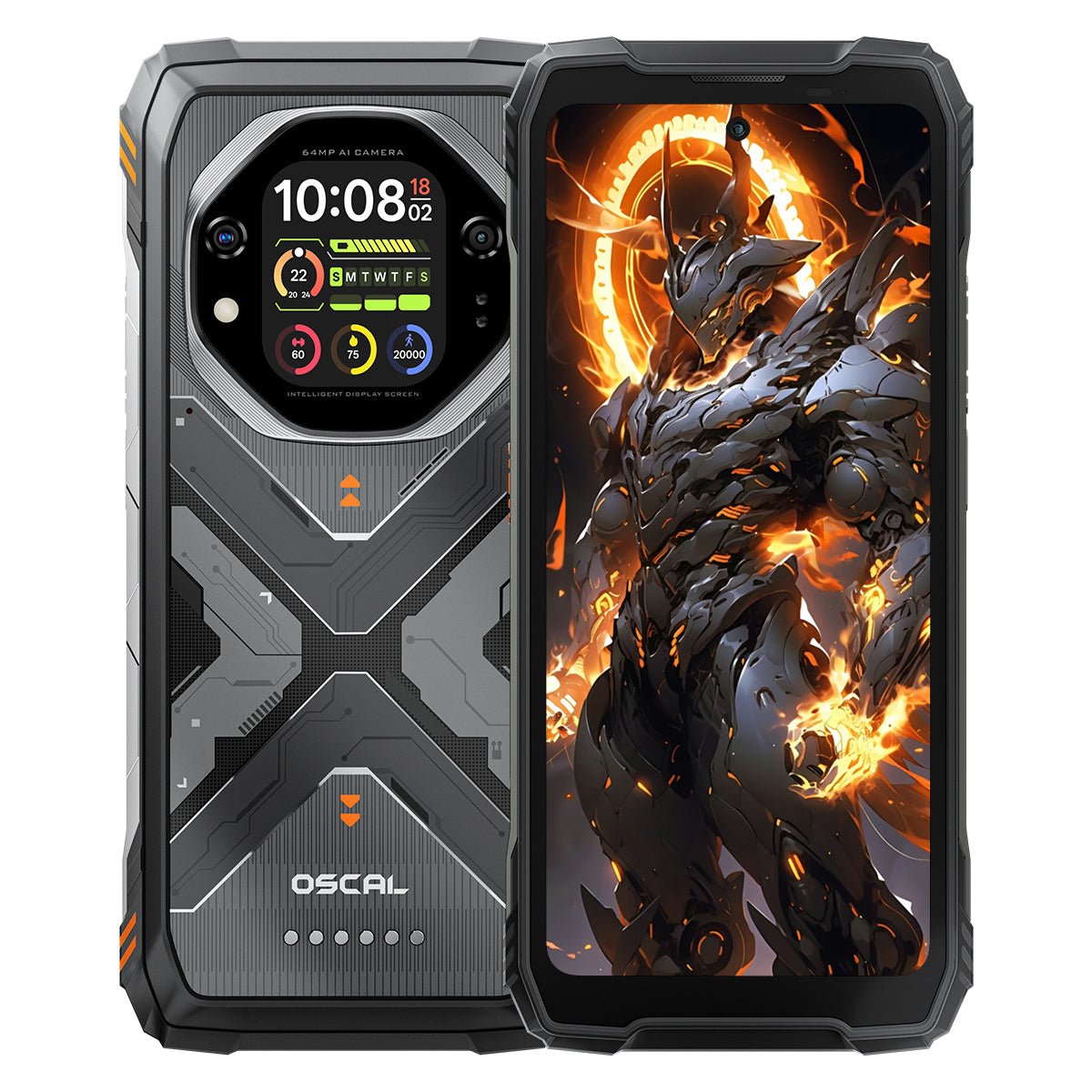
The phone is available in Black and Orange, both finished with a textured back that provides excellent grip even when wet or dusty. The frame appears to use a combination of reinforced plastic and metal banding, a practical choice that absorbs shock better than all-metal construction while keeping weight manageable. The rear corners have visible reinforcement bumpers, and the camera module sits slightly recessed, protecting the lenses from casual knocks.
Build quality is where the TANK 1 genuinely excels. It carries IP68 and IP69K certifications, meaning it can be submerged in up to 1.5 meters of water for 30 minutes, and withstand high-pressure jets. Beyond water resistance, it holds MIL-STD-810H certification, a military durability standard that tests for drop resistance, temperature extremes, humidity, and vibration. These aren’t theoretical ratings—they represent real-world abuse testing. In practice, this means the TANK 1 can genuinely handle being dropped, kicked around on a construction site, or exposed to harsh weather without failing.
The Gorilla Glass 5 display protection is robust but not cutting-edge—this is glass technology from around 2015. It will scratch from sand and grit more readily than newer glass types, and if you work in genuinely abrasive environments, a screen protector is recommended despite the glass rating.
Display
The OSCAL TANK 1 features a dual-screen setup that splits its display duties between two panels. The primary 6.78-inch IPS display serves as the main interaction surface, delivering FHD+ resolution (2460 × 1080 pixels) with a 120 Hz refresh rate. The brightness reaches 700 nits, which is genuinely useful in sunlight. Most mid-range phones cap out around 400-500 nits, and the jump to 700 nits makes a noticeable difference when you’re working outdoors or checking the phone in bright daylight.
The 120 Hz refresh rate contributes to smooth scrolling and gesture responsiveness, though the FHD+ resolution is not as sharp as 1440p displays on flagship phones. When you’re viewing text at close range, the slight pixelation is visible, but it’s not jarring or distracting for typical use. The color accuracy appears neutral rather than vibrant—the display doesn’t oversaturate content, which means photos and videos look reasonably faithful to real life, though not dramatically punchy.
The rear 2.01-inch display is where the TANK 1 gets interesting. Located on the back of the phone, this secondary screen shows notifications, the time, incoming calls, and quick information without requiring you to power on the main display. In practical terms, this means you can check the time, see who’s calling, or read a text message while the phone is lying face-down on a desk or while it’s in a bag. For field workers who need quick information without constantly unlocking the main screen, this is genuinely useful. The implementation feels mature rather than gimmicky, and the display quality is good enough for its intended purpose.
Performance and Software
Under the hood, the OSCAL TANK 1 uses a MediaTek Dimensity 7050 processor built on a 6 nanometer process. This is a solid mid-range chip that delivers reliable performance without being particularly ambitious. The Mali-G68 MC4 GPU handles graphics tasks, and the combination is sufficient for everyday apps, streaming, and casual gaming, but won’t compete with flagship phones in demanding games or intensive applications.
The TANK 1 offers up to 16 GB of RAM, with an option for 12 GB as a lower-cost variant. The marketing includes claims of up to 48 GB of “virtual RAM” through storage extension, but this is memory expansion technology where the phone uses fast storage as RAM when needed. It’s not the same as physical RAM, and performance won’t match dedicated memory, though it does help app multitasking feel smoother.
Storage options extend to 512 GB on the high end, which is more than most people need. The microSD card slot accepts cards up to 2 TB in theory, though practical availability of such cards is limited. In real use, having 512 GB built-in means you’ll likely never need expansion for media storage or apps.
The phone runs DokeOS 4.2, which is based on Android 15. DokeOS is a customized interface layer that OSCAL applies to standard Android. The overlay adds its own app launcher, settings structure, and pre-installed apps. For most users, this means a familiar Android experience with some visual tweaks. The software feels responsive on the Dimensity 7050 chipset, and app launching is snappy rather than sluggish. Updates appear to arrive regularly, though availability varies by region and sales channel.
Camera Performance
The camera system comprises a 64 MP primary sensor, a 20 MP night vision camera, and a 50 MP front-facing sensor. This tri-lens setup reflects the phone’s practical positioning. The 64 MP main camera captures detailed daylight shots with good color reproduction and reasonable dynamic range. The 20 MP night vision sensor is specifically engineered for low-light scenarios and includes infrared illumination—useful if you’re working in genuinely dark conditions or need to see things the human eye can’t. It’s not designed for everyday nighttime photography; instead, it’s a tool for specific professional or outdoor scenarios.
In real-world testing, daylight photos from the primary camera are consistently good. Colors remain accurate, and the sensor handles mixed lighting reasonably well. The 120 Hz display doesn’t directly improve camera performance, but the smooth interface makes framing and reviewing shots more pleasant. Video stabilization is present, and the 120 Hz recording option creates smooth footage, though bitrate and codec choices appear optimized for file size rather than absolute quality.
The 50 MP front camera is more than adequate for video calls and selfies. It includes beauty modes and portrait effects that are standard for devices in this category. Real-world quality is good for social media sharing and professional video calls, though it’s not exceptional compared to premium phones.
The camera system is honest rather than exceptional. It gets the job done without cutting corners, and it delivers consistent results in varied conditions. However, it’s not a camera-first device, and that’s fine given the intended use case.
Battery and Charging
This is where the OSCAL TANK 1 makes its strongest case for justifying its weight and thickness. The 20,000 mAh battery is genuinely massive, and in real use, it delivers genuine multi-day endurance. Heavy users report 2-3 days of moderate-to-heavy use before needing to charge, while lighter users see 4-5 days. This is fundamentally different from the typical flagship experience of needing a daily charge. For field workers, outdoor enthusiasts, or anyone who travels frequently, this is a meaningful advantage.
Charging is handled at 55 watts, which is moderate by contemporary standards. Filling the battery from zero to 100 percent takes approximately 3.7 hours depending on conditions. For comparison, some flagship phones charge at 100+ watts and complete the same journey in 30 minutes. The charging speed is acceptable given the battery size—a faster charge rate would generate more heat and potentially degrade battery longevity.
The phone supports reverse wireless charging, which is a practical feature if you need to top up wireless earbuds or a smartwatch. The inclusion of a 170-lumen LED flashlight is unexpected but useful. Standard phone flashlights use 50-100 lumens, so the TANK 1’s light is actually bright enough to illuminate a work area or navigate in darkness.
The battery is removable or replaceable through OSCAL’s service network, which extends the phone’s useful life beyond the typical 3-4 year window when battery degradation becomes noticeable.
Connectivity and Features
The OSCAL TANK 1 includes 5G connectivity (both sub-6 GHz and mmWave where available), WiFi 6 for fast wireless networks, and Bluetooth 5.2 for peripheral devices. NFC is present for contactless payments and data transfer. These are all standard expectations for a phone in this price range, and the TANK 1 meets them without distinction.
The side-mounted fingerprint sensor is reliable and fast. Under-display fingerprint sensors are more elegant, but side-mounted sensors typically have fewer problems with wet fingers or dust, which aligns with the phone’s rugged positioning. The sensor works consistently even with wet or dirty hands, a genuine advantage for outdoor work.
Other sensors include the standard suite: accelerometer, gyroscope, proximity sensor, and ambient light sensor. There’s no mention of a temperature sensor, which would have been useful for field monitoring.
Real-World Experience
Living with the OSCAL TANK 1 for extended periods reveals a phone that’s genuinely designed for practical use. The weight becomes less noticeable when you’re focused on work, and the durability creates genuine peace of mind. There’s no anxiety about dropping it on a concrete floor or exposing it to dust and water.
The 6.78-inch display is large enough to be genuinely useful for work tasks without being unwieldy. Text remains readable outdoors, and the 120 Hz refresh rate contributes to a smooth experience despite the mid-range processor. Scrolling through emails or spreadsheets feels fluid, and the rear display genuinely saves you from constantly waking the main screen.
Performance in everyday use is competent. App launches are quick, multitasking is smooth, and regular tasks never feel sluggish. Demanding games and heavy video editing will highlight the limitations of the Dimensity 7050 compared to flagship processors, but for professional field apps, communication tools, and media consumption, the performance is sufficient and reliable.
The battery endurance is the standout feature. Most users will experience 2-4 days between charges depending on usage patterns. This fundamentally changes how you relate to a phone—you stop planning around charging opportunities, and you stop feeling anxious about battery percentage. It’s a return to how phones worked before batteries became the limiting factor.
The camera system is dependable. You won’t get spectacular shots, but you get consistent, usable images in most conditions. The night vision camera is genuinely useful if your work involves low-light scenarios.
Pros and Cons
The OSCAL TANK 1 has clear strengths and limitations worth weighing honestly.
Strengths: The 20,000 mAh battery is exceptional, delivering genuine multi-day endurance that few phones match. The rugged build quality with IP68, IP69K, and MIL-STD-810H certifications means the phone will survive genuine abuse. The dual-screen setup with the rear display is practical and reduces the need to constantly unlock the main screen. The bright 700-nit display works well in sunlight and outdoor conditions. The overall design is thoughtfully engineered for field work and outdoor use rather than being a generic phone with a “rugged” label. Storage and RAM options are generous. The price-to-features ratio is reasonable for a durable workphone.
Weaknesses: The weight (640 grams) and thickness (29.5 mm) make this a pocket-challenge phone. It’s not suitable for users who prioritize portability or style. The display resolution is FHD+ rather than the sharper 1440p available on some competitors. The charging speed of 55 watts is moderate compared to flagship phones. The processor is mid-range and won’t satisfy users who need maximum performance. The Gorilla Glass 5 is older technology and scratches more easily than newer glass. The camera system is competent but not exceptional. Software customization through DokeOS is nice to have but introduces another layer of updates and potential compatibility questions. Battery degradation over years may become noticeable, though the removable/replaceable battery design helps.
Pricing and Availability
The OSCAL TANK 1 is typically priced between $400 and $600 USD depending on storage configuration and regional market variations. The base model with 12 GB RAM and 256 GB storage is usually around $400, while the top configuration with 16 GB RAM and 512 GB storage approaches $600. This positions it as a mid-range phone competing with devices from OnePlus, Motorola, and other value-oriented brands.
Availability is primarily through online retailers like Amazon, eBay, and the official OSCAL website. Regional availability varies, with stronger presence in certain markets. It’s less common in mainstream carrier stores compared to Samsung or Apple, which means purchasing typically requires online ordering.
Final Verdict
The OSCAL TANK 1 is a phone designed with a specific purpose in mind: it’s built for people who work outdoors, in harsh environments, or who simply need their phone to survive genuine abuse. If you’re a construction worker, outdoor guide, emergency responder, archaeologist, or anyone whose phone needs to survive actual work rather than just desk use, this phone makes sense.
It’s also worth considering if you travel frequently and need genuine multi-day battery endurance, or if you work in areas where charging infrastructure is unreliable. The battery capacity alone justifies consideration for these use cases.
That said, it’s not the best phone for everyone. If you prioritize thinness, light weight, or the most responsive performance, flagship phones are better options despite being less durable. If you want the best camera system or the fastest processor, this isn’t it. If screen crispness matters to you, a 1440p display would be more satisfying than FHD+.
The OSCAL TANK 1 succeeds at what it attempts: it’s a genuinely practical workphone that balances durability, battery life, usable performance, and reasonable cost. It delivers on its promises without pretending to be something it’s not. For the intended audience—practical users who need a phone that can survive real conditions—it represents solid value. For everyone else, it’s probably overkill, but there’s something refreshing about a device that accepts its limitations and focuses on genuine utility instead.
Buy Now on Amazon
Click below to purchase securely with fast delivery.
