
This post may contain affiliate links. If you buy something through one of these links, Tech Info Central may earn a small commission at no extra cost to you.
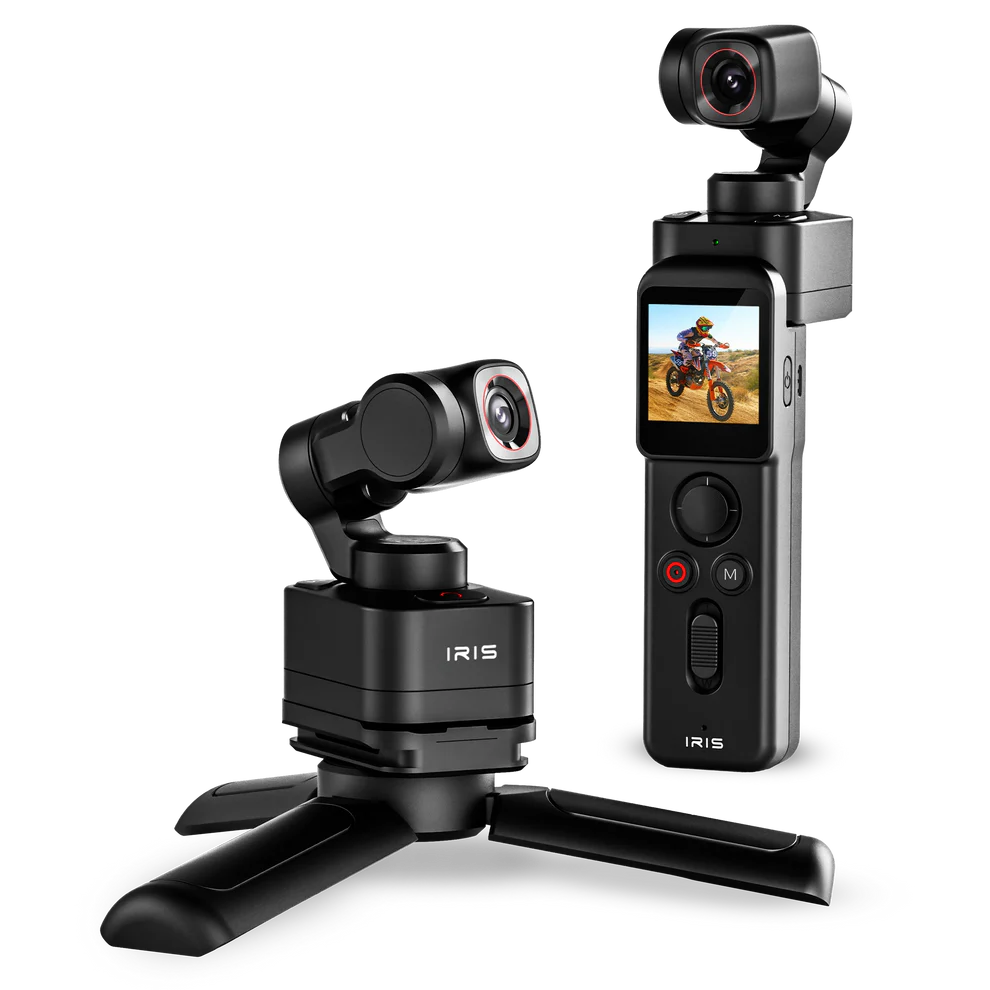
This IZI IRIS review looks at a pocket gimbal camera with one genuinely unusual trick: the camera can detach from the main body.
That immediately gives the IRIS possibilities that a conventional fixed pocket camera cannot match.
The camera module can be positioned separately for creative angles while the main unit provides monitoring and control.
IZI combines that modular design with a 1/1.3-inch CMOS sensor, three-axis mechanical stabilisation, 4K video at up to 60 frames per second, AI subject tracking and dual AMOLED displays.
On paper, it sounds like a creator’s dream.
The more useful question is what those specifications actually mean, and where caution is warranted when comparing a smaller camera brand with established rivals.
IZI IRIS key specifications
| Sensor | 1/1.3-inch CMOS |
| Maximum video | 4K at 60fps |
| Stabilisation | 3-axis mechanical gimbal |
| Main display | 1.5-inch AMOLED |
| Secondary display | 0.42-inch AMOLED |
| Tracking | AI subject tracking |
| Storage | microSD up to 512GB |
| Claimed battery life | Up to 160 minutes |
| Creative modes | Panorama, time-lapse, hyper-lapse and slow motion |
| Design | Detachable camera/gimbal system |
The detachable design is the reason to pay attention
Most pocket gimbal cameras follow the same basic idea.
The camera sits permanently on top of a handheld gimbal body.
IZI has taken a different approach.
The IRIS camera unit can detach, opening up mounting angles and positions that would be awkward with the entire grip attached.
That could be useful for solo creators.
You might position the camera lower to the ground, attach it to an appropriate mount or find a more interesting angle while retaining remote control.
It also makes the IRIS more than a straight specification comparison with another pocket camera.
Its strongest argument is flexibility.
The 1/1.3-inch sensor
Sensor size matters because a larger imaging area can collect more light than a smaller sensor when other factors are comparable.
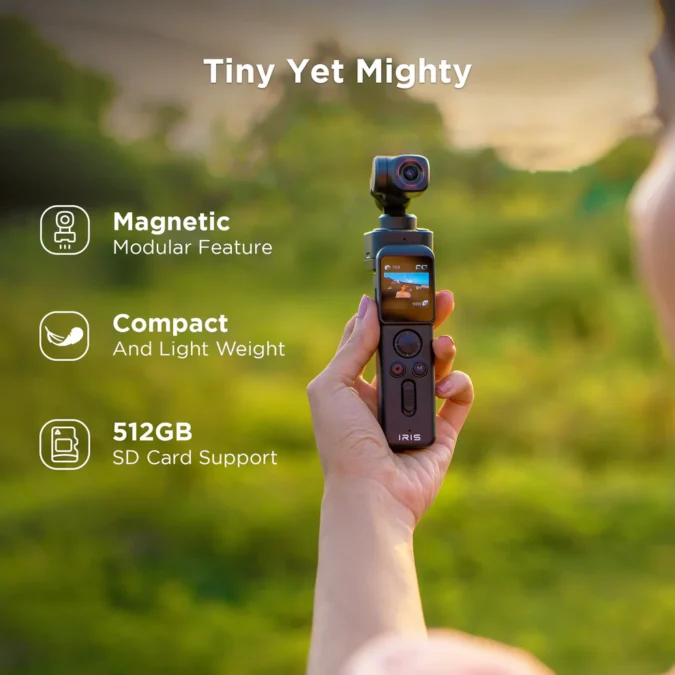
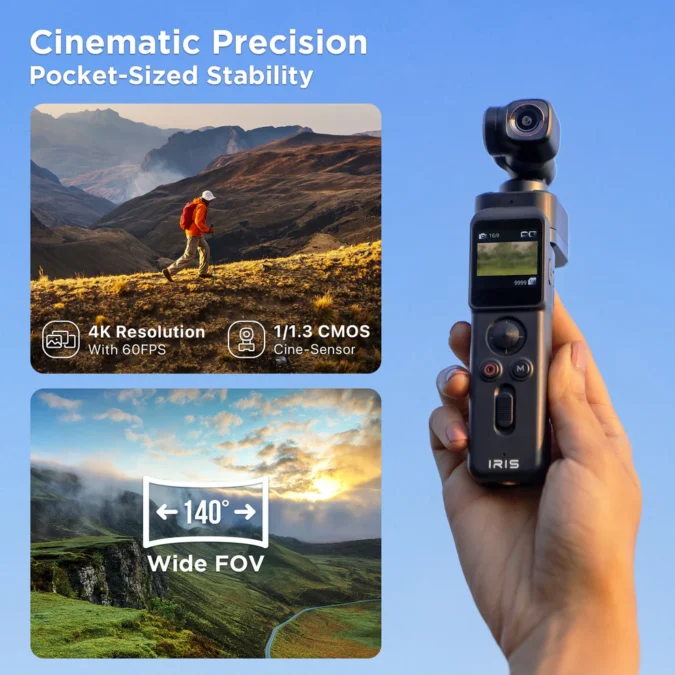
IZI uses a 1/1.3-inch CMOS sensor in the IRIS.
That is a strong specification for a compact creator camera.
The company makes ambitious claims about image quality and low-light performance.
Those claims should still be separated from independent testing.
Sensor size provides a useful technical foundation, but lens quality, exposure algorithms, noise reduction, colour processing and bitrate all influence the final image.
Because TechInfoC has not performed a controlled side-by-side camera test, we are not going to claim that the IRIS automatically produces better low-light footage than a competing camera simply because of the sensor specification.
That would require actual comparative footage.
4K at 60fps gives creators useful flexibility
The IRIS records video at up to 4K and 60 frames per second.
That gives users the choice between normal high-resolution footage and smoother 60fps capture for movement.
For YouTube, travel content and social video, 4K/60 is a sensible ceiling.
It provides enough resolution for reframing and cropping during editing while retaining smooth motion when required.
Whether you actually need to record everything in 4K is another matter.
Higher resolution consumes storage more quickly and can make editing more demanding.
For plenty of social content, lower resolutions remain perfectly adequate.
Having the option is what matters.
Three-axis mechanical stabilisation
The IRIS uses a three-axis gimbal rather than relying solely on electronic stabilisation.
Mechanical gimbals physically move the camera to counteract unwanted motion.
That makes this category particularly attractive for walking footage, travel vlogs and creator shots where holding a conventional camera steady would be difficult.
IZI describes the result as smooth, shake-free footage.
That is the manufacturer’s claim.
Actual stabilisation quality can depend on walking technique, gimbal tuning, horizon calibration and how aggressively the camera has to compensate.
Still, a physical three-axis gimbal gives the IRIS the right hardware for this kind of shooting.
Dual AMOLED displays make sense for vlogging
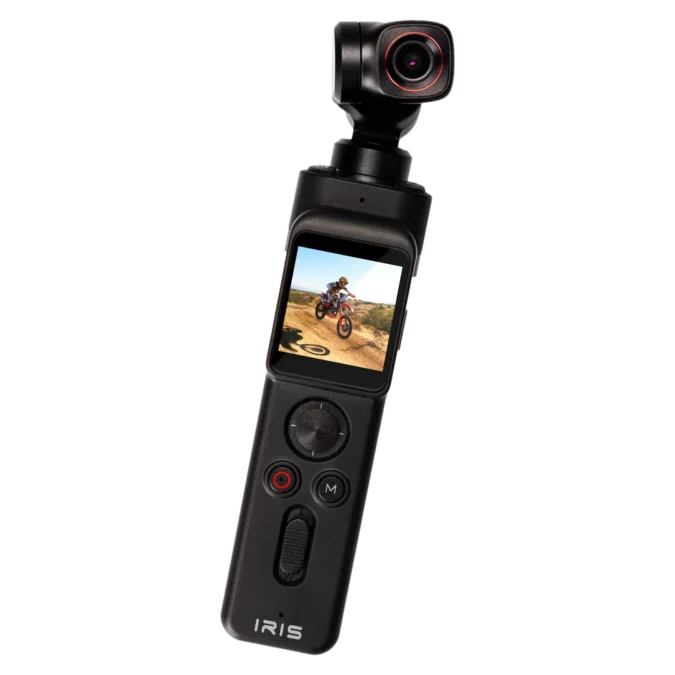
The main AMOLED display measures 1.5 inches, while a smaller display provides additional information and framing assistance.
A front-facing view is especially useful for solo creators.
One of the biggest frustrations when filming yourself is discovering afterwards that the composition was wrong.
Being able to monitor the shot while standing in front of the lens reduces that risk.
For a camera marketed at vloggers, this is a practical feature rather than a specification added simply to make the product sheet longer.
AI tracking
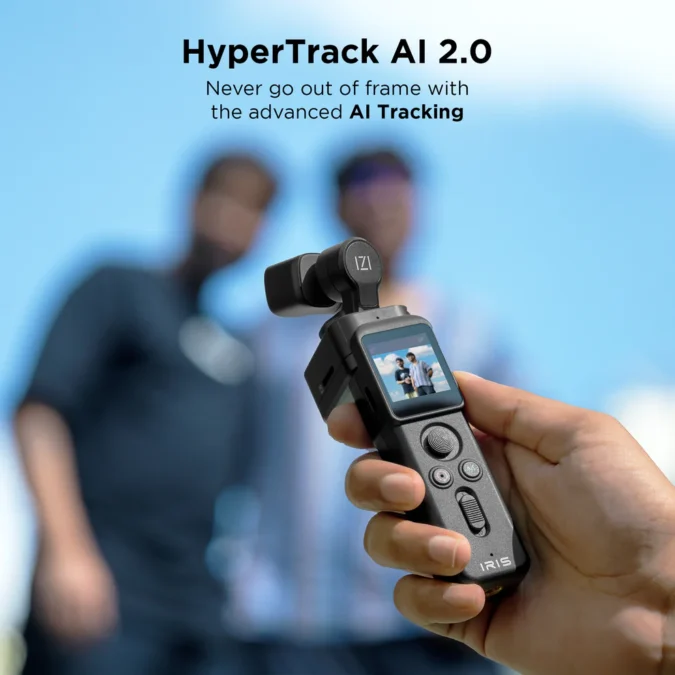
The IRIS includes AI-assisted subject tracking.
The idea is straightforward: identify a person or subject and allow the gimbal to keep that subject framed as they move.
That can be particularly useful for somebody filming without another camera operator.
A cooking demonstration, workout, product presentation or walking piece to camera becomes much easier if the camera can follow movement automatically.
As with any tracking system, reliability matters more than the words “AI tracking” on the box.
Without long-term hands-on testing, we cannot promise that it will never lose a subject or become confused by complicated scenes.
But the feature fits the IRIS’ target audience extremely well.
Storage up to 512GB
The IRIS supports microSD cards with capacities up to 512GB.
That is useful because 4K footage consumes storage quickly.
Removable storage also makes workflow management easier.
You can keep multiple cards, transfer footage through a reader and avoid being locked into a fixed amount of internal storage.
For longer trips or events, that flexibility can matter more than it initially appears.
Battery life: up to 160 minutes
IZI advertises up to 160 minutes of recording time.
Treat that as a manufacturer maximum rather than a guaranteed result.
4K/60 recording, display brightness, tracking and wireless features can all affect battery consumption.
Still, an advertised figure approaching three hours is encouraging for a pocket gimbal camera.
Anyone filming professionally should carry a charging solution regardless.
Few things ruin a shoot faster than discovering that a tiny battery icon has become the most important thing in the frame.
What’s included?
IZI’s current product information lists an accessory package including the IRIS camera and remote, wrist strap, USB cables, tripod stand, carrying bags, protective shell and magnetic clamp.
Package contents can change, so buyers should check the current listing before ordering.
That is a useful approach because creator cameras tend to become expensive once the necessary mounting accessories are purchased separately.
A reasonable starter kit lowers that barrier.
Audio deserves attention
IZI advertises a 360-degree audio capture system.
For casual vlogging, integrated audio may be enough.
For serious creator work, microphone quality is one of the areas I would investigate before purchasing.
Audiences will forgive imperfect video surprisingly quickly.
Bad audio becomes exhausting.
If dialogue quality matters to your work, look for raw sample recordings or confirm compatibility with the external microphone setup you intend to use.
Do not buy a camera based solely on the words “360-degree audio”.
How does the IRIS compare with established pocket cameras?
The obvious comparison is with the wider pocket-gimbal category.
The IRIS has several appealing specifications, particularly the large sensor, 4K/60 recording and detachable design.
Its challenge is ecosystem maturity.
Larger camera brands generally benefit from a broader library of independent tests, firmware history, accessories, tutorials and third-party support.
That does not make the IRIS worse.
It simply means buyers should research the complete ownership experience rather than comparing headline resolution alone.
The detachable design is the feature that could justify choosing it over a more conventional rival.
If you do not need that flexibility, the decision becomes much closer.
Price and value
The IRIS sits in a part of the market where buyers should expect more than novelty but may still be trying to avoid the cost of larger interchangeable-lens camera equipment.
Value will depend heavily on how much you use the detachable design and tracking features.
For someone who regularly films alone, those functions could be genuinely useful.
For someone who mainly shoots static scenes from a tripod, much of the IRIS’ appeal disappears.
IZI IRIS pros and cons
Pros
- Detachable camera design
- 1/1.3-inch CMOS sensor
- 4K recording at up to 60fps
- Three-axis mechanical stabilisation
- Dual AMOLED displays
- AI subject tracking
- microSD support up to 512GB
- Useful accessory bundle
- Claimed battery life of up to 160 minutes
- Strong feature set for solo creators
Cons
- Smaller ecosystem than established camera brands
- Manufacturer image-quality claims need independent verification
- AI tracking performance can vary by scene
- 4K footage consumes storage quickly
- Serious creators may still want an external microphone solution
Who should buy the IZI IRIS?
The strongest buyer is a solo creator.
If you film yourself regularly, the combination of tracking, front monitoring, stabilisation and detachable positioning could genuinely simplify your workflow.
Travel vloggers may also appreciate having one compact device instead of carrying a camera and separate handheld gimbal.
The IRIS is less compelling for somebody who mainly shoots static scenes from a tripod.
In that situation, many of its most unusual features go unused.
Final verdict
The IZI IRIS stands out because it is trying something more interesting than simply squeezing another camera into a smaller box.
Its detachable design gives creators shooting options that conventional pocket gimbals cannot reproduce as easily.
The core specification is competitive too.
A 1/1.3-inch sensor, 4K/60 recording, three-axis stabilisation, dual displays and AI tracking give the camera plenty of potential.
The part that deserves caution is performance.
Manufacturer specifications tell us what hardware is present. They do not tell us everything about autofocus consistency, low-light processing, microphone quality or long-term firmware support.
For that reason, the IRIS looks most attractive to creators who specifically value its modular design.
If that feature fits the way you shoot, this is a pocket camera worth investigating.
If it does not, compare the wider ecosystem and real sample footage carefully before making the purchase.