
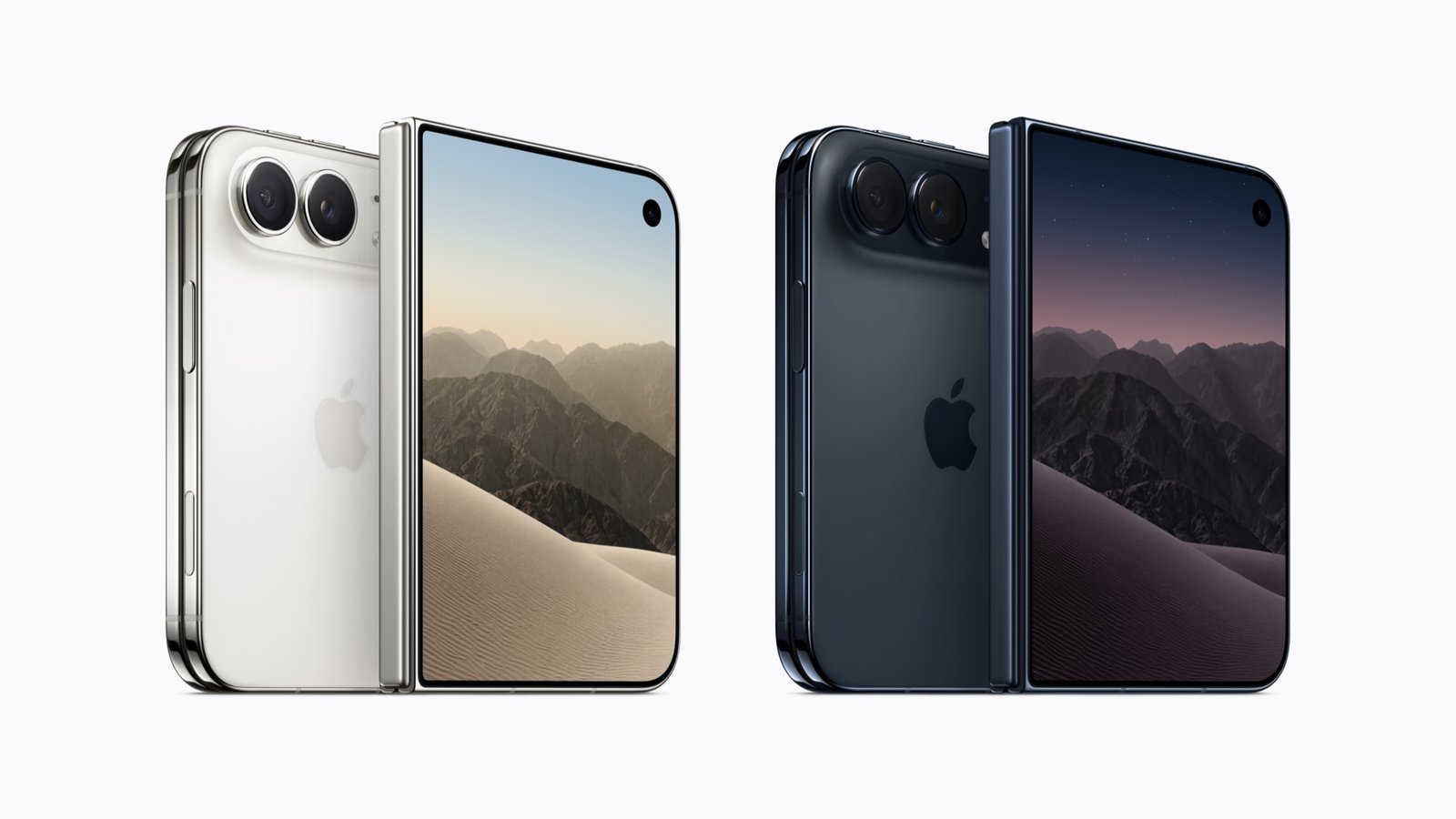
The iPhone Duo is Apple’s most radical iPhone in years, but spending $1,999 on the company’s first foldable deserves considerably more thought than Apple’s launch presentation allowed.
Yes, the headline features are exciting. It folds. It opens into a 7.6-inch display. It runs the same A20 Pro chip as Apple’s latest Pro phones. It introduces proper side-by-side multitasking to the iPhone. There is even Apple Pencil support, something iPhone owners have waited years to see.
Then you start looking closely.
There is no Face ID. There is no dedicated telephoto camera. The main camera misses the new variable-aperture system Apple has just introduced on the iPhone 18 Pro. Apple Pencil support will arrive after launch and works with the cheaper USB-C Apple Pencil rather than Apple Pencil Pro. The Action Button has disappeared. Every iPhone Duo sold worldwide is eSIM-only.
Then there are the questions that matter even more on a $1,999 foldable.
How will that inner screen look after 50,000 folds? Or 100,000? How will the hinge feel after two years in a pocket? Will the crease become more visible? What happens to battery life when people spend most of their day using the 7.6-inch display rather than Apple’s smaller outer screen?
Apple has answers for some of these questions. For others, it simply cannot have real-world customer data yet.
The iPhone Duo was announced on 9 September 2026. Pre-orders begin on 16 October and the phone reaches customers on 23 October. That means any publication claiming to offer a genuine long-term iPhone Duo review right now is getting ahead of reality. citeturn406192search0turn923965search2
This article takes a different approach.
Rather than pretending we have lived with a phone that has not shipped, we have gone through Apple’s specifications, its launch material and early hands-on reporting to examine what prospective buyers actually need to know before committing two thousand dollars to Apple’s first-generation foldable.
And there is quite a lot to talk about.
iPhone Duo key specifications
| Specification | iPhone Duo |
|---|---|
| Starting price | $1,999 / £1,999 |
| Storage | 256GB, 512GB, 1TB, 2TB |
| Outer display | 5.4-inch Super Retina XDR OLED |
| Inner display | 7.6-inch folding Super Retina XDR OLED |
| Refresh rate | ProMotion, up to 120Hz on both displays |
| Peak outdoor brightness | Up to 3,000 nits |
| Processor | Apple A20 Pro |
| Rear cameras | 48MP Main + 48MP Ultra Wide |
| Telephoto | 2x optical-quality crop from Main camera |
| Front camera | 12MP Center Stage outer camera |
| Inner camera | Under-display FaceTime camera |
| Authentication | Side-mounted Touch ID |
| Face ID | No |
| Apple Pencil | USB-C Apple Pencil, coming later in 2026 |
| Apple Pencil Pro | No |
| Weight | 254g |
| Thickness open | 5.2mm |
| Thickness folded | 11.3mm |
| Battery claim | Up to 24 hours typical use |
| Inner-screen video playback | Up to 31 hours |
| Outer-screen video playback | Up to 44 hours |
| Wireless charging | MagSafe and Qi2 up to 25W |
| Water/dust resistance | IP68 |
| SIM | eSIM-only worldwide |
| Release date | 23 October 2026 |
Apple’s technical specifications confirm the 254g weight, 11.3mm folded thickness, dual-camera system, Touch ID, eSIM-only design, 25W MagSafe charging and support for the USB-C Apple Pencil. citeturn576422search0turn523418view2
Those specifications are impressive in isolation.
The important question is what they mean once $1,999 leaves your bank account.
1. $1,999 is the starting point, not the price of the iPhone Duo
Let’s deal with the uncomfortable number first.
The iPhone Duo starts at $1,999 for 256GB.
Move to 512GB and the price rises to $2,199. The 1TB model costs $2,599, while the fully loaded 2TB version reaches an extraordinary $3,199. citeturn406192search6
Apple has taken a similarly aggressive approach in Britain. The 256GB iPhone Duo starts at £1,999, with the 2TB version reaching £3,199. citeturn923965search1
That immediately changes how the Duo needs to be judged.
This is not simply an unusual iPhone for people who fancy trying a foldable. Apple has positioned it above its conventional Pro phones in price while using the same A20 Pro processor found inside the iPhone 18 Pro range.
An iPhone 18 Pro Max starts at $1,299 with 256GB of storage.
That means the entry-level Duo demands another $700.
What does that $700 buy?
Primarily, it buys the folding experience.
You get a much larger 7.6-inch internal display, an unusual compact outer form, new multitasking capabilities, flexible viewing positions and a device that can occupy territory somewhere between an iPhone and a small iPad.
What it does not buy is an across-the-board upgrade over the iPhone 18 Pro Max.
That distinction matters.
Apple’s conventional flagship actually has several hardware advantages, particularly in photography and biometrics. So the purchase decision cannot be reduced to “Duo costs more, therefore Duo is better”.
It isn’t that simple.
The iPhone Duo is effectively a specialist flagship. You are paying for the form factor.
That may be worth every penny to the right buyer. Someone who regularly reads documents, edits photos, watches video, browses desktop-style websites or works between two apps could get far more value from 7.6 inches of usable screen than they would from another incremental camera upgrade.
But anyone who buys according to the traditional Apple hierarchy needs to understand this before ordering.
The most expensive iPhone is no longer automatically the iPhone with the strongest specification in every category.
The iPhone 18 Pro Max starts $700 lower while retaining Apple’s more advanced Pro camera system. citeturn488847search0
That may prove to be the most important comparison of this entire generation.
2. The folding display is the real reason to buy it
Strip away the novelty and the iPhone Duo’s argument comes down to one thing: screen space.
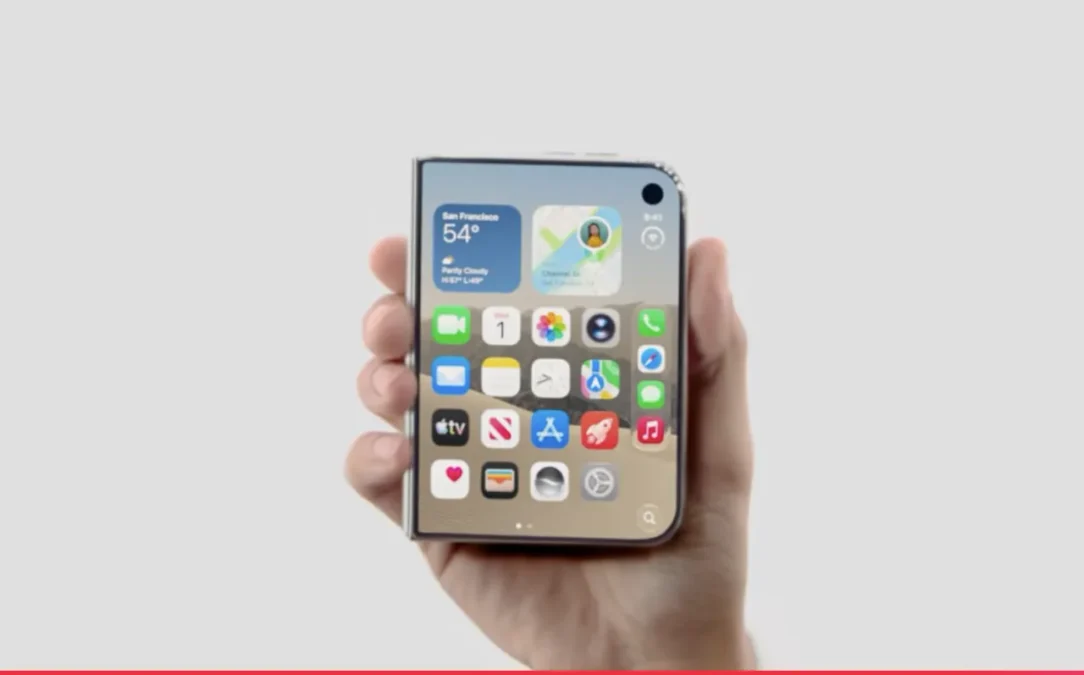
Closed, you have a 5.4-inch outer OLED display.
Open the device and you get a 7.6-inch Super Retina XDR folding OLED panel with a resolution of 1,878 by 2,670 pixels.
Both screens support ProMotion with adaptive refresh rates up to 120Hz, Always-On display functionality, HDR, True Tone and outdoor brightness reaching 3,000 nits. citeturn576422search0
Those numbers tell only half the story.
The point of a foldable is what happens when software starts treating that larger canvas as more than a stretched phone screen.
Apple has rebuilt parts of iOS 27 around the Duo.
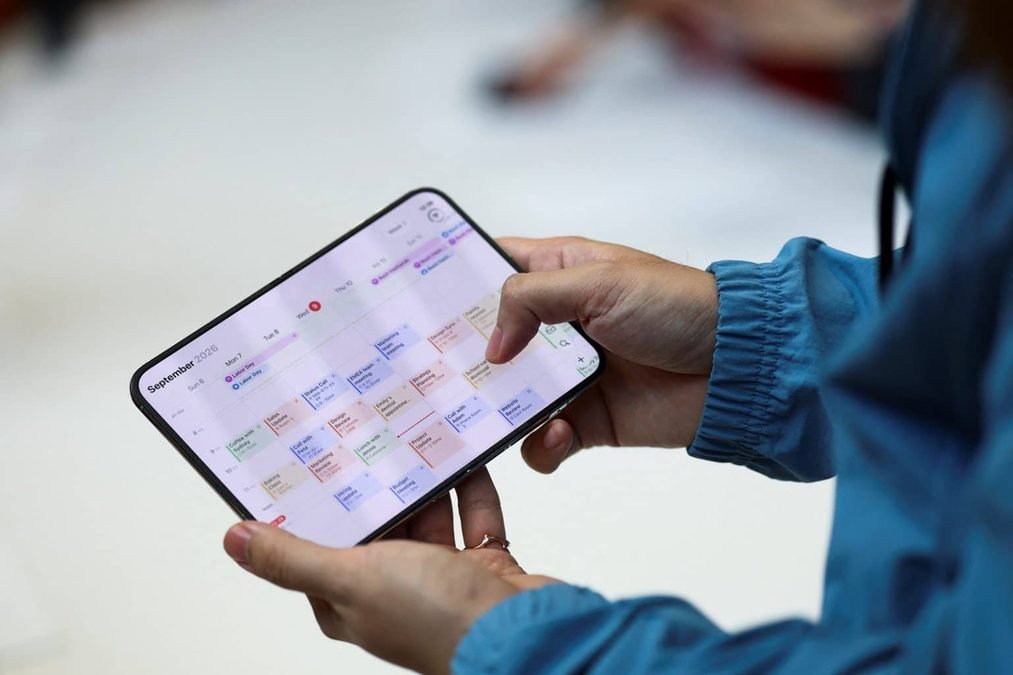
Split View finally allows two iPhone apps to run side by side. You can open two windows from the same application, including two Safari windows, swap apps between sides and save app pairings that you want to return to later.
That could fundamentally change how some people use an iPhone.
Imagine having Mail open beside Calendar while arranging a meeting.
Messages beside Safari while researching a purchase.
Notes beside a browser while working.
A video playing on one side while social media occupies the other.
For years, the iPhone’s performance has exceeded what its single-app interface allowed many users to exploit. Duo gives all that processing power somewhere to go.
Apple also uses the hinge itself as part of the interface.
The device can be partially folded and placed on a surface for video, FaceTime or StandBy. The outer display can act as a preview when someone else is taking your photograph. Apps can respond to orientation and folding position rather than simply switching between portrait and landscape.
Apple describes the inner display as 50 per cent larger than the iPhone 18 Pro Max display. citeturn923965search5
That is the Duo’s killer feature.
It also explains why comparing it purely against the iPhone 18 Pro Max specification by specification misses part of the point.
A 7.6-inch foldable display creates experiences that a conventional 6.9-inch phone simply cannot reproduce.
The real question is how often you would actually open it.
If your Duo stays closed 80 per cent of the day, that $700 premium starts looking harder to justify.
If you open it constantly, it could become one of those technologies that makes returning to a normal smartphone feel strangely restrictive.
That is why buyers should think about usage rather than hype.
Don’t ask whether a folding iPhone looks impressive.
Ask yourself what you would do on that screen tomorrow morning.
If you already know the answer, the Duo begins making sense.
3. Face ID is gone, and the Action Button has disappeared too
One of the strangest compromises on a $1,999 iPhone is something Apple users have taken for granted since the iPhone X.
The iPhone Duo does not have Face ID.
Apple has instead returned to Touch ID, integrating a fingerprint reader into the side button.
Apple says this provides consistent authentication whether the Duo is open or closed. citeturn576422search6
There is logic behind the decision.
A foldable has to authenticate in several physical configurations. Face ID hardware takes up space, and Apple’s inner display also uses an under-screen FaceTime camera in pursuit of a cleaner uninterrupted panel.
A side-mounted fingerprint reader works regardless of which display you are using.
It could even be quicker in certain situations. Your finger naturally reaches the side button as you pick the phone up.
Still, this represents a significant behavioural change for long-time iPhone owners.
Face ID has become almost invisible in daily use. You look at your phone and it authenticates. Password managers unlock. Apple Pay confirms identity. Banking applications recognise you.
On the Duo, your finger becomes part of that process again.
Whether that feels like a downgrade will depend on personal preference, but buyers should know about it before spending $1,999.
Then there is another curious omission.
The iPhone Duo has no Action Button.
Apple’s specifications show volume buttons, a side button with Touch ID and Camera Control, but the programmable Action Button found on recent iPhones is absent. MacRumors also notes that this leaves the Duo without a dedicated physical mute control, meaning Silent Mode can instead be accessed through software such as Control Centre. citeturn923965search0
That is the sort of detail that can disappear beneath a flashy launch presentation.
It also reinforces a recurring theme with the Duo.
Apple has clearly prioritised internal space, thinness and hinge engineering. Familiar iPhone features have occasionally been sacrificed to make the foldable design possible.
Whether those sacrifices matter to you is more important than whether they look significant on a specification sheet.
4. The cameras are powerful, but this is not Apple’s best camera phone
This might be the biggest surprise for buyers who assume a $1,999 iPhone must also be Apple’s ultimate photography device.
It isn’t.
The iPhone Duo has two rear cameras:
- a 48MP Fusion Main camera
- a 48MP Fusion Ultra Wide camera
Apple advertises 0.5x, 1x and 2x shooting options.
The important detail is that there is no dedicated telephoto camera.
The 2x mode comes from Apple’s 48MP main sensor, producing what the company calls a 12MP “optical-quality” 2x Telephoto image.
In other words, there is no separate long focal-length lens sitting behind that 2x button. citeturn523418view5
Compare that with the iPhone 18 Pro and Pro Max.
Those models have a three-camera Pro Fusion system including a dedicated 48MP telephoto camera. Apple advertises up to 8x optical-quality zoom on the Pro models. citeturn923965search10
The Duo also misses another major iPhone 18 Pro feature: variable aperture.
The iPhone 18 Pro’s main camera can physically alter its aperture, giving photographers greater control over light and depth of field.
The Duo’s main camera uses a fixed ƒ/1.6 aperture. citeturn523418view6
For an ordinary smartphone this would still qualify as an extremely capable camera setup.
For a two-thousand-dollar flagship launching alongside Apple’s most advanced camera system, the omission deserves attention.
There are some clever advantages created by the foldable design.
Duo Preview can place a live camera preview on the outer screen, allowing your subject to see the composition.
You can use the high-quality rear cameras for selfies while framing yourself on the second display.
Smart Take uses on-device processing to detect when subjects are posing and can automatically capture a photograph.
Kid Cue plays animations on the outer screen to encourage children to look towards the camera.
The phone can also stand partially folded, effectively giving you a built-in support for photographs and video.
Those are genuinely interesting additions. citeturn406192search0
But they do not change the underlying hardware comparison.
If your priority is zoom, maximum photographic flexibility or Apple’s new variable-aperture system, the iPhone 18 Pro or Pro Max is the stronger choice.
That feels strange to write about a device costing $1,999.
It is also exactly the sort of thing prospective buyers deserve to know.

5. Apple Pencil support sounds better than it initially is
An Apple Pencil working on an iPhone has been rumoured for what feels like forever.
The iPhone Duo finally makes it happen.
There are two catches.
First, Apple Pencil support will not be available when the phone launches on 23 October.
Apple says it is coming later in 2026. citeturn576422search6
Second, the Duo supports the USB-C Apple Pencil, rather than Apple Pencil Pro.
That distinction is more significant than the names suggest.
Apple Pencil Pro includes pressure sensitivity, squeeze gestures, haptic feedback, barrel roll functionality, Find My support and magnetic pairing and charging on compatible iPads.
The USB-C Pencil is Apple’s simpler model. It supports useful basics such as tilt sensitivity, but lacks several of those higher-end features.
MacRumors reports that the Duo will support the USB-C Pencil on both its inner and outer displays, but Apple Pencil Pro compatibility is absent. citeturn523418search2
For note-taking, document annotation and occasional sketching, that may be perfectly adequate.
For artists hoping the Duo would become a miniature iPad Pro that happens to make phone calls, expectations should be adjusted.
There is another practical question.
Where do you put the Pencil?
The USB-C model does not magnetically attach and charge from the Duo in the way Apple Pencil Pro does on a compatible iPad.
So the first iPhone with Apple Pencil support also makes the stylus something else you have to carry.
That does not ruin the feature.
It simply makes Apple’s implementation feel more like a useful addition than a complete transformation of the iPhone into a pocketable creative tablet.
And because the software arrives after launch, anyone buying the Duo specifically for Apple Pencil should wait until Apple actually releases the feature and its behaviour can be tested properly.
6. The iPhone Duo is eSIM-only everywhere
Apple has gradually pushed American iPhone customers towards eSIM for several generations.
The iPhone Duo takes that strategy global.
There is no physical SIM version of the iPhone Duo anywhere in the world.
Apple’s technical specifications state that the phone supports two active eSIMs and can store eight or more profiles. A physical SIM card cannot be inserted. citeturn523418view7
Apple says removing the physical SIM hardware helps maximise internal space for battery capacity.
From an engineering perspective, that makes sense. Space is at a premium in a foldable this thin.
For many users, eSIM is also convenient. Plans can be activated digitally, multiple profiles can live on one device and switching between supported networks can be much easier than hunting for a SIM ejector tool.
The problem appears when travelling somewhere your preferred network, prepaid provider or local carrier still relies heavily on physical SIM activation.
Apple says eSIM is supported by more than 500 carriers worldwide. citeturn406192search0
That is substantial coverage.
It still means buyers who travel frequently should check their specific carriers and destinations before ordering.
This is particularly important for people who routinely arrive in another country and purchase a cheap local physical SIM at the airport.
With the Duo, that habit has to change.
The eSIM-only design also means there is no alternative version you can import to work around the decision.
This is the global model.
Before buying, check that your home carrier supports eSIM properly. Then check any networks you depend on while travelling.
Do that before the phone arrives, rather than discovering the limitation while standing at an airport mobile shop.
7. It is astonishingly thin open, but fairly chunky when you actually carry it
Apple has every right to boast about one particular figure.
Open, the iPhone Duo is just 5.2mm thick.
That is an impressive piece of engineering considering Apple has packed a 7.6-inch folding display, two batteries, an A20 Pro chip, camera hardware, speakers, antennas, a vapour chamber and a hinge into the device.
Then you close it.
Folded thickness becomes 11.3mm.
And the phone weighs 254g. citeturn576422search0
That changes the conversation considerably.
An unfolded device can be exceptionally thin while still feeling substantial in a trouser pocket because, of course, you carry it folded.
Eleven millimetres is hardly outrageous for a book-style foldable, but this will feel different from a conventional iPhone.
The unusual proportions could matter as much as the raw thickness.
Closed, the Duo is only 84.1mm wide and 117.8mm tall. It has the compact, almost passport-like shape Apple has leaned into.
That could make it pleasantly easy to hold despite the thickness.
The weight is harder to disguise.
At 254g, this is a substantial phone.
For context, the iPhone 18 Pro Max is already a large flagship, yet official comparison figures put the Duo slightly heavier. More importantly, that weight is concentrated into a smaller object when the phone is closed. citeturn576422search3
This is something specifications cannot fully communicate.
Balance matters.
Hinge resistance matters.
How the device sits in a pocket matters.
Whether it feels reassuringly solid or annoyingly dense depends on factors that require prolonged physical use.
Early hands-on reporting has praised the hinge feel and compact proportions. citeturn576422news102
That is encouraging.
But spending five minutes with a phone at a launch event is very different from carrying it for ten hours.
Anyone particularly sensitive to heavy phones should handle the Duo in person before ordering.
At $1,999, buying on measurements alone seems unnecessarily risky.
8. Apple has reduced the crease, but nobody knows how it will age
Every book-style foldable has one awkward physical reality.
The screen bends in the same place thousands of times.
Apple says the iPhone Duo’s inner screen uses a special nano-texture finish and an adhesive system designed to allow display layers to move as the device folds.
The company says this helps minimise stress and the visibility of the crease.
Notice the word minimise.
Apple does not claim that a crease physically does not exist.
MacRumors spotted something particularly interesting in Apple’s own FAQ. When discussing whether the inner display shows a crease, Apple describes the panel as flat and smooth and explains the technology used to minimise the crease, rather than declaring it crease-free. citeturn576422search2
Early impressions are positive.
The Verge’s hands-on report described the crease as difficult to notice during its limited time with the phone. citeturn523418news42
That matters.
Apple may genuinely have produced one of the best-looking folding displays yet.
But launch-day visibility is only one part of the durability question.
What does that crease look like after six months?
Does repeated folding make it more visible?
Does the coating wear differently around the hinge?
Does texture change?
Does dust or grit eventually leave marks?
How does it behave after thousands of transitions between hot outdoor temperatures and air-conditioned rooms?
Nobody outside Apple can currently answer those questions with meaningful real-world evidence.
That is not an accusation against the Duo.
It is a reality of every first-generation product with a new mechanical display.
The sensible position sits between two extremes.
There is little reason to assume the screen will fail simply because it folds.
There is equally little reason to assume Apple’s marketing language settles the long-term durability question.
The phone needs time in customers’ hands.
That will take months, rather than hours.
For early adopters, this uncertainty comes with the territory.
For somebody hoping to keep a $1,999 phone for four or five years, it deserves serious consideration.
9. Apple has not published a hinge-cycle rating
This might be the most curious omission in Apple’s durability story.
The iPhone Duo’s hinge is extremely sophisticated.
Apple says it contains more than 100 components, uses a 3D-printed titanium cover and works with internal structural reinforcement to support the display and maintain stiffness. The device also carries an IP68 rating for water and dust resistance. citeturn576422search8
Those are impressive engineering claims.
What Apple has not provided is a number showing how many folding cycles the hinge is rated to survive.
As of the announcement, there is no published iPhone Duo equivalent of “tested for X hundred thousand folds”.
MacRumors highlighted the omission while noting that Samsung has publicly quoted fold-cycle figures for competing devices, including a reported 500,000-fold rating for the Galaxy Z Fold8. citeturn523418search0
A fold-cycle number is never a guarantee of how long an individual phone will last.
Laboratory conditions cannot replicate every pocket, temperature, grain of sand, accidental drop or awkward one-handed opening.
Still, numbers provide buyers with useful context.
At $1,999, some customers will reasonably want to know what Apple considers the intended mechanical lifespan of the hinge.
The absence of a public figure does not prove the hinge is fragile.
It simply leaves one of the biggest durability questions unanswered.
Apple has clearly invested enormous engineering effort here. An IP68 rating on a folding device is particularly encouraging because moving hinges and dust resistance have historically been difficult companions.
There is plenty to feel positive about.
But durability is an area where time has more authority than a keynote.
If you buy the Duo on day one, you are effectively volunteering to be part of the first enormous real-world durability trial.
Some technology enthusiasts will love that.
Others should wait.
10. Battery life looks promising, and yes, MagSafe is here
One detail that could easily become confused in the flood of launch coverage is MagSafe.
The iPhone Duo does support MagSafe.
Apple’s technical specifications list MagSafe wireless charging at up to 25W alongside Qi2 charging at up to 25W.
There is a magnetic array and alignment system inside the device, and Apple’s own Duo cases support magnetic attachment and charging. citeturn523418view3turn923965search4
So existing discussion suggesting that the Duo somehow abandons MagSafe should be treated cautiously.
Apple simply did not make MagSafe one of the headline features of the announcement.
Battery life is more complicated.
The Duo uses two internal batteries, one on either side of the folding body.
Apple claims:
- up to 24 hours of typical use
- up to 31 hours of video playback using the inner display
- up to 44 hours of video playback using the outer display
Those are respectable figures. citeturn576422search0
They also demonstrate why foldable battery testing needs more nuance than normal smartphone testing.
Which screen did you use?
How long was the device unfolded?
Were two applications running simultaneously?
Were you gaming across the large display?
Did you spend the day on the smaller outer screen?
Those behaviours could produce dramatically different results.
Apple’s own video figures already show a 13-hour gap between playback on the outer and inner displays.
That makes perfect sense. A larger 7.6-inch panel requires more power.
But the entire reason to pay $1,999 for a Duo is to use that larger display.
Nobody wants to buy a foldable and then deliberately avoid unfolding it because they are worried about battery life.
Apple’s 24-hour “typical use” estimate attempts to account for mixed usage, but the meaningful test will come when ordinary people use the Duo as their primary phone.
There is also fast charging.
Apple says the phone can reach 50 per cent in around 20 minutes using a suitable 60W-capable wired adapter, or around 30 minutes using an appropriate MagSafe setup. citeturn523418view2
Again, promising.
But battery endurance, heat and long-term battery health are exactly the kind of things nobody can responsibly judge from a launch event.
The A20 Pro and vapour-chamber cooling system should help efficiency and sustained performance.
The dual-cell design is clever.
Now we need real-world data.
11. The biggest unknown is what living with a first-generation foldable iPhone actually feels like
This is the point that specification comparisons struggle to capture.
Apple has built foldable-specific functionality directly into iOS 27.
Its own applications have been optimised for the Duo. Developers have APIs for adapting their software. Split View can run apps side by side, applications can react to different folding positions and the operating system can move content intelligently between the outer and inner displays. citeturn406192search0
Apple has also had years to watch Samsung, Google, Huawei, Honor and others learn painful lessons about foldable software.
That could give the Duo an unusually mature first-generation experience.
There will still be surprises.
Third-party applications will vary.
Some developers will embrace the larger canvas immediately.
Others may simply stretch their existing iPhone interface.
Social media applications could look wonderful or ridiculous depending on how they handle the almost tablet-like inner proportions.
Games may require updates.
Keyboard behaviour will matter.
Rotation will matter.
Multitasking memory management will matter.
How quickly an application moves from outer to inner display will matter.
Even tiny things such as where menus appear when the phone is partially folded can determine whether a foldable feels genuinely useful or like an expensive engineering demonstration.
Apple’s advantage is vertical integration.
The company controls the hardware and operating system, and it has an enormous developer ecosystem.
If any company can make a foldable feel coherent from its first generation, Apple has the ingredients.
But ingredients are not the finished meal.
The final judgement requires living with the Duo.
Getting up in the morning and reaching for it.
Using Maps outside.
Answering calls.
Typing long messages.
Taking photographs quickly.
Using it one-handed.
Watching videos on a flight.
Charging it overnight.
Putting it in a pocket hundreds of times.
Opening and closing it thousands of times.
Discovering which applications you instinctively use unfolded and which ones you never bother opening the phone for.
That is where the real iPhone Duo review will be written.
And that review cannot exist until the device reaches customers on 23 October 2026.
So, is the iPhone Duo worth $1,999?
For some people, absolutely.
For everyone else, there is a strong argument for waiting.
The Duo is one of the most interesting iPhones Apple has produced in years precisely because it changes the basic relationship between phone size and screen size.
A conventional large smartphone forces you to carry a large slab all day.
The Duo compresses a much larger screen into a compact folding body.
That opens possibilities that another 10 per cent improvement in processor performance never could.
Reading should be better.
Browsing should be better.
Multitasking should be dramatically better.
Video should be more immersive.
Documents, spreadsheets, remote-desktop applications, photo editing and productivity tools suddenly have room to breathe.
There is genuine substance behind the novelty.
At the same time, Apple’s first foldable asks buyers to accept a surprising list of compromises.
No Face ID.
No dedicated telephoto camera.
No variable aperture.
No Action Button.
No physical SIM.
No Apple Pencil Pro.
No Apple Pencil support at launch.
No published hinge-cycle rating.
No long-term crease data.
And, for now, no independent long-term battery or durability evidence.
That would be a meaningful list on a $999 phone.
At $1,999, it deserves even more scrutiny.
Who should buy the iPhone Duo?
The Duo makes the strongest case for people who already know why they want a foldable.
If you regularly wish your iPhone gave you more working space, frequently carry both an iPhone and small tablet, use your phone heavily for productivity, consume large amounts of video or simply love experimenting with genuinely new hardware, the Duo could be exactly the sort of device you have been waiting for.
There is also a group of Apple users who have watched Android foldables from afar because they never wanted to leave iOS.
For them, price may be secondary.
The Duo finally provides the foldable experience without abandoning iMessage, FaceTime, iCloud, AirDrop, Apple Watch, AirPods and the rest of the Apple ecosystem.
That alone will make it extremely compelling.
Who should wait?
Photographers should look closely at the iPhone 18 Pro and Pro Max before ordering.
You get Face ID, Apple’s more advanced camera system, a dedicated telephoto lens, variable aperture, the Action Button and a significantly lower starting price.
Anyone concerned about long-term reliability should also wait for durability testing.
The same goes for buyers who keep phones for four or five years.
A conventional iPhone already has years of accumulated reliability data behind its basic physical design.
The Duo introduces a folding OLED panel, complex multi-component hinge and dual-battery architecture all at once.
That does not make it unreliable.
It means its long-term reliability record begins on 23 October.
There is a difference.
And if Apple Pencil is one of your main reasons for buying the device, wait until the feature actually launches.
There is no advantage in paying $1,999 today for software Apple says will arrive later.
iPhone Duo versus iPhone 18 Pro Max: the decision in one sentence
Buy the iPhone Duo if the folding 7.6-inch display will genuinely change how you use your phone.
Buy the iPhone 18 Pro Max if you mainly want Apple’s strongest conventional flagship, particularly for photography, battery certainty, familiar ergonomics and value.
That sounds almost too simple.
It is also the heart of the decision.
The Duo does not replace the Pro Max by beating it at everything.
It creates a different category.
The most exciting thing about the iPhone Duo might also be its biggest risk
Apple has spent years allowing other manufacturers to establish the foldable market before entering it.
That patience shows.
The Duo does not look like a hurried response to Samsung.
The 7.6-inch display, titanium structure, sophisticated hinge, IP68 rating, A20 Pro chip, 120Hz panels, MagSafe, dual batteries and deeply integrated multitasking suggest Apple has taken the category seriously.
Early hands-on impressions of the hinge and inner display are encouraging. citeturn576422news102
And yet there is no escaping what this product represents.
Generation one.
The first folding iPhone.
The first time millions of Apple users may depend on a flexible display as their primary phone screen.
The first chance we have to observe how Apple’s hinge technology survives years rather than controlled laboratory testing.
The first chance developers have to design specifically around a folding iPhone.
That is exciting.
It also means the smartest purchasing decision may depend less on how much you love the Duo and more on how comfortable you are paying to join the experiment at the beginning.
Some people bought the original iPhone because they wanted to see the future before everyone else.
The iPhone Duo carries a little of that feeling.
The difference is that this glimpse of the future starts at $1,999.
Final verdict
The iPhone Duo might be Apple’s most fascinating product of 2026.
It could also be the easiest iPhone to buy for the wrong reason.
Do not buy it simply because it is Apple’s most expensive phone.
Do not buy it assuming the highest price automatically gives you the best camera.
Do not buy it because “first foldable iPhone” sounds impressive.
Buy it because you want what the folding display actually enables.
That distinction changes everything.
The 7.6-inch screen, proper multitasking, flexible viewing positions and compact folded design give the Duo capabilities no conventional iPhone can match.
The A20 Pro means performance should be exceptionally strong. Apple has retained MagSafe. The device has IP68 resistance, 120Hz displays, premium titanium construction and some genuinely clever camera tricks made possible by having screens on both sides.
There is plenty here to be excited about.
There are also compromises buyers deserve to see in large print rather than buried in a specification page.
Touch ID replaces Face ID.
The dedicated telephoto camera is gone.
Variable aperture belongs to the cheaper iPhone 18 Pro models.
The Action Button disappears.
Apple Pencil Pro is unsupported.
USB-C Apple Pencil compatibility arrives later.
Physical SIM cards are gone worldwide.
And the questions surrounding hinge longevity, crease development, battery performance and long-term inner-screen durability will remain questions until people have actually lived with the device.
That last point matters most.
The iPhone Duo launches on 23 October 2026.
Until then, the sensible approach is curiosity rather than certainty.
Apple has shown us what the Duo is designed to do.
The next job is discovering how well it does it after the keynote lights have gone out.
For $1,999, buyers deserve that evidence.
And unless you already know exactly why you need a folding iPhone, waiting for it could be the smartest feature of all.