
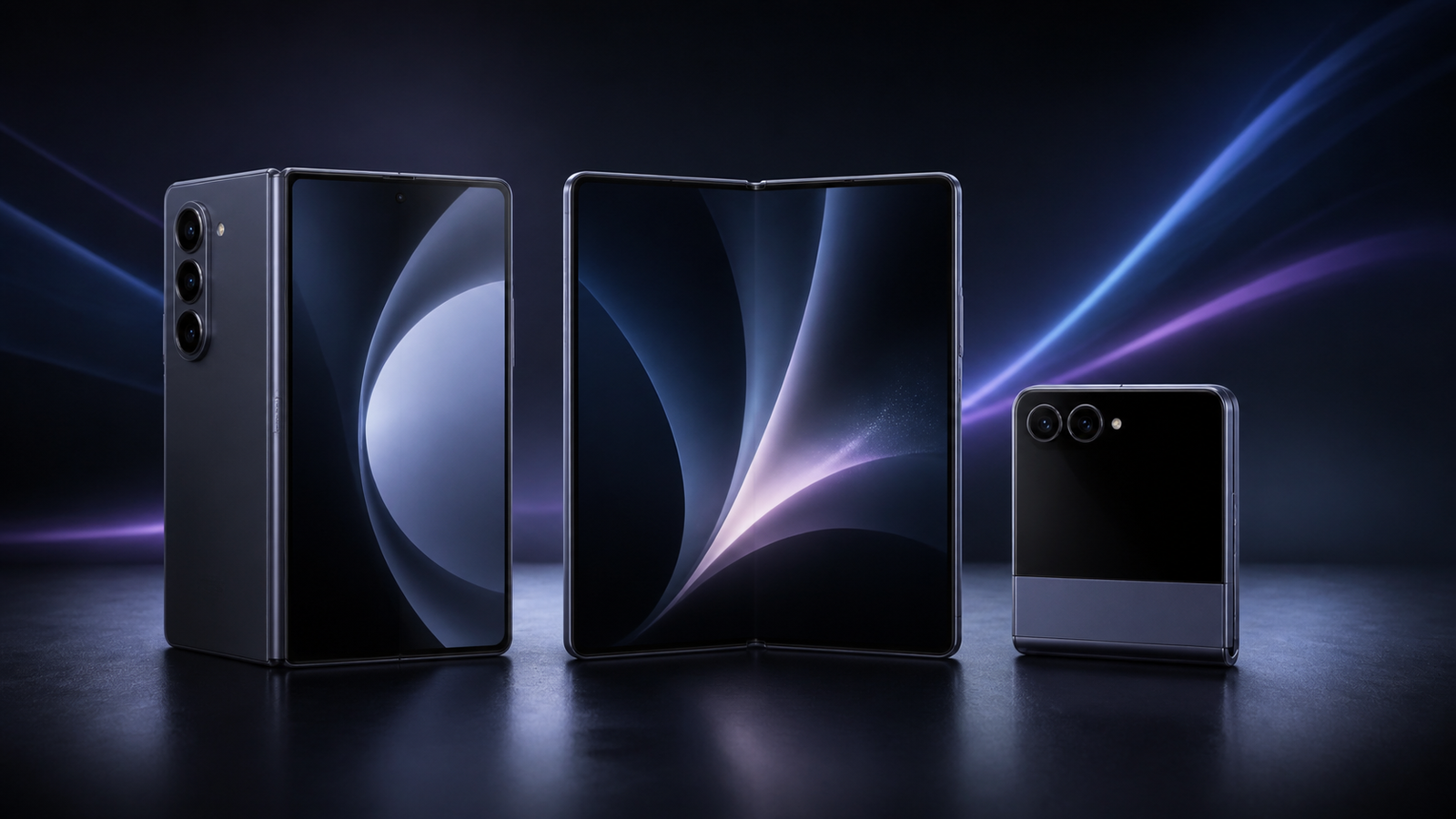
Galaxy Z Fold 8 vs Fold 8 Ultra vs Flip 8 is the comparison that reveals three genuinely different personalities in Samsung’s 2026 foldable range: a compact flip phone for everyday carry, a light book-style Fold made for entertainment, and an Ultra model built to replace more of your work gear. That distinction matters. For years, a foldable buying decision was mostly about choosing between a large phone that opened into a tablet and a smaller phone that folded in half. This generation is more deliberate. Samsung is trying to serve three kinds of owner instead of simply filling a price ladder.
Affiliate disclosure: This article may contain affiliate links. If you buy through one of these links, we may earn a commission at no additional cost to you. This does not influence our editorial conclusions or product recommendations.
The headline is not that all three phones can bend. It is that they bend for different reasons. The Galaxy Z Flip 8 is designed to make a full-size smartphone easier to carry and quicker to use without opening it. The Galaxy Z Fold 8 changes the shape of the traditional book-style Fold into something more comfortable for video, browsing and reading. The Galaxy Z Fold 8 Ultra keeps the familiar tall Fold format, but adds the widest productivity canvas, the most ambitious camera hardware and the strongest battery-and-charging package of the trio.
That makes the choice more nuanced than “buy the most expensive one.” A bigger inner display is useful only if you regularly work with more than one app, edit photos, read long documents or enjoy films on a screen that approaches small-tablet territory. A 200MP camera is meaningful only if you want the extra flexibility it brings. Conversely, a phone that disappears into a pocket, sits on a table as its own tripod and lets you respond to a message from its cover screen may improve daily life more than an 8-inch workspace.
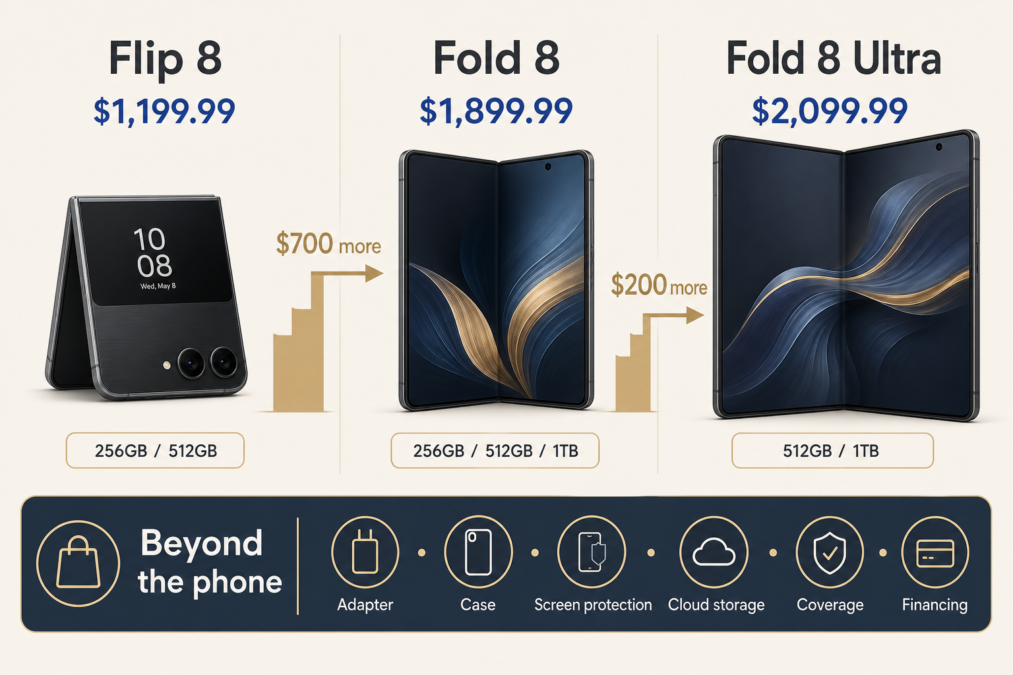
This guide breaks down the official specifications, the real-world implications of the designs and the compromises to consider before spending premium-foldable money. Pricing and availability can vary by market and carrier, but Samsung lists US starting prices of $2,099.99 for the Fold 8 Ultra, $1,899.99 for the Fold 8 and $1,199.99 for the Flip 8. All three were announced in July 2026 and began general availability in the United States on August 7, 2026.
The short answer: which Galaxy Z is right for you?
Choose the Galaxy Z Flip 8 if you want the most portable and expressive phone in the range. It is the clear choice for people who want a normal-size main display, a small folded footprint, flexible selfie and video framing, and a cover screen useful enough to reduce how often they open the phone. It is also the least expensive way into Samsung’s latest foldable hardware.
Choose the Galaxy Z Fold 8 if entertainment, reading and browsing are the priority. At 201g, it is Samsung’s lightest book-style Fold yet, and its unusual 4:3 inner display is intended to make video feeds, articles, games and web pages feel more natural. This is the Fold for someone who wants a compact media device that still fits in a jacket pocket.
Choose the Galaxy Z Fold 8 Ultra if your phone is a work tool as much as a personal device. Its 8-inch screen, 6.5-inch cover display, 200MP main camera, 3x telephoto lens, 5,000mAh battery and 45W charging create a more complete flagship proposition. It is expensive, but it is the model with the strongest case for replacing a smaller tablet or reducing the need to carry a second camera.
None of these is objectively best in isolation. The Ultra offers the broadest capability, but the Fold 8 may be the more enjoyable media device for some users, while the Flip 8 is much easier to live with in a pocket or small bag. Start with how you use your phone on an ordinary Tuesday, not with the spec sheet.
At a glance: the important differences
| Feature | Galaxy Z Fold 8 Ultra | Galaxy Z Fold 8 | Galaxy Z Flip 8 |
|---|---|---|---|
| Main display | 8.0-inch Dynamic AMOLED 2X | 7.6-inch Dynamic AMOLED 2X | 6.9-inch Dynamic AMOLED 2X |
| Cover display | 6.5-inch | 5.5-inch | 4.1-inch FlexWindow |
| Weight | 215g | 201g | 180g |
| Rear cameras | 200MP wide, 50MP ultra-wide, 10MP 3x telephoto | 50MP wide, 50MP ultra-wide | 50MP wide, 12MP ultra-wide |
| Battery | 5,000mAh | 4,800mAh | 4,300mAh |
| Wired charging | 45W | 45W | 25W |
| US starting price | $2,099.99 | $1,899.99 | $1,199.99 |
All three use 120Hz adaptive main displays, run Android 17 with One UI 9, support 5G and Wi-Fi 7, and carry an IP48 rating. IP48 means protection against solid objects larger than 1mm and water immersion under Samsung’s stated laboratory conditions; it is reassuring, but it does not make a foldable a beach or pool phone. The phones also share Samsung’s broader Galaxy AI direction, although the larger Folds give those features more room to work while the Flip makes them accessible from the cover display.
Galaxy Z Fold 8: a different kind of book-style foldable
The standard Galaxy Z Fold 8 is the most interesting design experiment in the line. Instead of treating the smaller Fold as a cheaper version of the Ultra, Samsung has given it a notably different shape. Folded, it has a 5.5-inch cover screen in a 10:16 ratio. Open it, and the 7.6-inch inner panel uses a 4:3 ratio. That sounds technical, but it changes the experience considerably.
A tall, narrow book-style foldable often feels like two devices joined together: a phone outside and a small tablet inside. The Fold 8 leans harder into the second identity. A 4:3 panel is close to the shape of older tablets and computer displays, which means articles, web pages, comic panels and image-heavy feeds can look less cramped. Samsung also says the wider shape reduces unused screen space in content-focused apps and can show a post alongside its comments more comfortably. For someone who spends downtime watching, reading or researching, this layout may be the key reason to pick the Fold 8 rather than the Ultra.
The trade-off is that the cover screen is intentionally compact. It is designed for quick messages, a social scroll, a map check or a short video, not for replacing the roomy outer display of the Ultra. That will be a benefit for buyers who want the device to feel purpose-built when unfolded, but it may annoy anyone who expects to do most one-handed tasks while the phone remains closed. It is wise to handle one in person before buying: display proportions affect comfort more than raw diagonal measurements suggest.
At 201g, the Fold 8 is lighter than the Ultra and unusually light for a phone that opens into a 7.6-inch screen. Its folded dimensions are 81.9 x 123.9 x 9.7mm, while it measures 4.5mm at its thinnest when open, excluding the inner screen frame. The result is a device that should feel less like carrying a miniature laptop and more like carrying a dense, premium phone that has a second mode when you need it.
Samsung equips the Fold 8 with the Snapdragon 8 Elite Gen 5 Mobile Platform for Galaxy, up to 16GB of memory on the 1TB version, and 256GB, 512GB or 1TB storage options. Those are serious specifications, but the better question is what the screen enables. A research session can keep a browser, notes app and messaging window visible. A long flight can become a legitimate movie-and-reading session. A recipe, instruction manual or game guide can stay open without constantly switching back and forth. The Fold 8 is not merely for running three apps at once; it is for giving one activity enough visual breathing room.
Its camera system is also more capable than the “standard” label implies. The rear setup uses a 50MP wide camera with optical image stabilization and a 50MP ultra-wide camera. The wide lens supports 2x optical-quality zoom, while digital zoom reaches 10x. The lack of a dedicated telephoto camera is the main photographic distinction from the Ultra. For travel, concerts, wildlife and portraits that benefit from true optical reach, the Ultra is better equipped. For landscapes, group photos, food, everyday family images and social video, the Fold 8’s twin 50MP approach is a strong, relatively balanced setup.
Battery capacity is 4,800mAh, which is substantial given the device’s 201g weight. Samsung rates its 45W wired system for up to 63% in around 30 minutes with the compatible adapter and cable, and the phone also supports 20W fast wireless charging and Wireless PowerShare. Real endurance will depend heavily on how much time the inner display spends at high brightness, whether gaming or 5G is involved, and the intensity of AI features. Still, the larger battery addresses one of the central anxieties of using a foldable as a primary device: a big screen should not force you to hunt for a charger by late afternoon.

Galaxy Z Fold 8 Ultra: the true work-and-create flagship
The Galaxy Z Fold 8 Ultra is Samsung’s first Ultra-branded foldable, and the name is justified by more than an upgraded camera. This is the model intended for people who want a large-screen phone to do serious multitasking, complex communication, editing and capture without giving up the conveniences of a conventional flagship when it is folded.
Its 8-inch QXGA+ inner display has a 2504 x 2256 resolution, 120Hz adaptive refresh rate and a square-ish shape that suits a two-app or three-app workspace. The 6.5-inch outer screen is also large enough to feel familiar for texting, navigation, calls and quick app use. That matters: unlike the Fold 8, the Ultra does not ask you to reserve full comfort for the open state. Folded, its 72.8mm width is close to that of a traditional phone; unfolded, its 143.2mm width becomes a productive canvas.
The Ultra is 215g and measures 8.9mm folded or 4.1mm unfolded, excluding the inner display frame. Those figures make its ambition easier to appreciate. It provides a screen this large without the thickness and weight once associated with early foldables. It is still a premium, carefully engineered device that deserves a case and thoughtful handling, but it no longer makes the same obvious portability trade-off as a small tablet.
Camera hardware is the clearest upgrade. The Ultra combines a 200MP main camera, 50MP ultra-wide camera and 10MP telephoto camera with 3x optical zoom. The 200MP sensor supports HDR in its full-resolution mode, while the ultra-wide is built for wider scenes and close-up macro work. Samsung also highlights improved low-light processing, 8K recording at 30fps using the APV codec and Cine LUT tools for creators who want more control over color and tone. Specifications never guarantee a better photo in every situation, software processing, movement and light are decisive but the Ultra is unequivocally the more versatile camera phone in this lineup.
That versatility changes how the foldable form factor can be used. Open the phone to review a photo on a large panel, refine a crop, compare variations and share the result without moving it to a tablet or laptop. Prop the half-folded device on a surface for a hand-free shot. Use the large display to monitor footage or make a quick edit. Content creators should not assume it will replace a dedicated camera system, especially for long-lens work or professional productions, but it has the most credible single-device creation workflow of the three.
The Ultra’s 5,000mAh battery and 45W dual-path charging architecture complete that claim. Samsung says it can reach up to 67% in around 30 minutes using its 45W adapter and a 3A USB-C cable; the adapter is sold separately. It also supports up to 20W wireless charging. The improved graphite cooling structure is worth noting, too. High-end chips are powerful, but a large display, sustained video capture, gaming, live navigation and multitasking can create heat. Better heat dissipation is not glamorous, but it can be the difference between a fast phone in a short demo and a reliably responsive phone across a long day.
The Ultra uses the same Snapdragon 8 Elite Gen 5 Mobile Platform for Galaxy as the Fold 8 and offers 12GB of memory with 256GB or 512GB storage, or 16GB with 1TB storage. Buy the 1TB tier only if you know that you keep a library of large video files, shoot frequently or store work assets locally. Cloud storage, fast transfers and streaming make 512GB sufficient for many people. But for a phone explicitly pitched at 8K capture and on-device creation, 1TB is not a frivolous configuration.
The biggest argument against the Fold 8 Ultra is price. At $2,099.99 before trade-ins, cases, insurance and accessories, it costs as much as a high-end phone plus a capable tablet. It earns that price only when the large display, high-end cameras and better charging solve real needs. If you mostly use messaging, social apps, standard photos and video streaming, the Flip 8 or a conventional flagship will make more financial sense. If you already carry a phone and tablet everywhere, the Ultra can make a more compelling consolidation case.

Galaxy Z Flip 8: the foldable for daily convenience
The Galaxy Z Flip 8 approaches the problem from the opposite direction. It does not try to replace a tablet. It tries to make a large smartphone less intrusive when you are not using it and more expressive when you are. Folded, it measures 75.4 x 85.7 x 13.1mm and weighs 180g. Open, its 6.9-inch display provides the familiar tall canvas most people expect from a modern phone.
The design is attractive because it solves a very mundane problem: modern phones are large, flat rectangles that can dominate a pocket, small bag or hand. The Flip 8 becomes a smaller square when closed, while retaining a 6.9-inch main display when opened. That makes it a lifestyle choice in the best sense, not an ornamental device, but one shaped around how people actually carry and use their phones.
Its 4.1-inch FlexWindow is central to the appeal. Samsung calls it an AI-native interface rather than just a secondary notification display. It supports selected apps, insights and actions, and surfaces Now Brief cards with contextual information and suggestions. The company also says Gemini Intelligence can be invoked from the FlexWindow with the side key or voice requests for connected tasks. In practical terms, this should let you check a message, control media, glance at an update, run a quick action or begin a voice request without unfolding the phone.
That is useful only if it reduces friction rather than adding another interface to manage. Buyers should treat AI as an assistive layer, not a reason to hand over routine decisions without review. Automation may depend on app support, accounts, region, permissions and an internet connection. It is nevertheless easy to see why the Flip benefits from this approach: its cover screen is close at hand when the full display would be unnecessary.
The Flip 8 is also the most naturally social camera of the three. Its 50MP wide camera, 12MP ultra-wide camera and 10MP front camera are not as flexible as the Ultra’s triple-camera system, but the fold itself creates useful shooting modes. Flex Mode allows hands-free shooting at different angles. Camcorder Grip and a Zoom Rocker aim to make handheld video more stable and comfortable. Super Steady adds a Horizontal Lock option, while the outer display can be used for previews, cover-screen selfie video and mirror-like checks before a photo. Put simply, the Flip lets you use its better rear cameras for self-portraits while still seeing your framing.
The 4,300mAh battery is smaller than the Folds’ cells, as expected in a lighter clamshell design. Samsung rates 25W wired charging at up to 55% in about 30 minutes with a compatible 25W charger and cable, plus 15W wireless charging. This is adequate rather than class-leading. Heavy camera use, extended 5G navigation and long main-screen sessions will still test the battery. The value of the FlexWindow is that quick interactions may keep the energy-hungry main display off more often, but it is not a substitute for a large battery.
Performance configurations include 12GB of memory and either 256GB or 512GB of storage. Samsung’s official specifications note that chipset availability can vary by market, so check the exact local product page before purchasing if the processor is a deciding factor. This is especially important for buyers who game heavily, use demanding editing software or care about long-term performance comparisons. For most day-to-day uses, the practical priorities are screen quality, battery behavior, camera workflow and whether a clamshell truly suits your routine.

Displays, hinges and durability: what has changed?
Samsung’s most meaningful shared upgrade is its focus on making foldables feel less compromised. The company’s Fold 8 and Fold 8 Ultra use a new Flex Titanium display structure, described as a titanium-alloy film combined with an enhanced titanium plate. Samsung says this helps create slimmer designs, improves durability and reduces crease visibility. Both large Folds also reach up to 3,000 nits of peak brightness, with Vision Booster and a low-reflection finish. Outdoor readability is one of the less glamorous but most valuable specifications for a device designed around a large display.
It is important to be precise about durability. An IP48 rating is progress, and improved materials should inspire more confidence than the first generations of foldables. Yet inner flexible screens are still not identical to the glass panel on a slab phone. They deserve sensible care: avoid pressing hard on the crease, keep abrasive debris away from the hinge, and use a protective case that does not interfere with folding. Water resistance is not a promise of saltwater, sand or soap resistance. A foldable is robust enough for normal life, not invulnerable.
The Flip 8’s hinge serves a different purpose. Its most visible benefit is positional: half-open it on a table, use it as a stand for a group photo, video call or time-lapse, and use the cover screen for quick tasks when closed. The Fold hinges exist largely to transform a phone into a broader work or entertainment surface. The hardware may share engineering goals, but the daily behavior it enables is different.
Software, AI and the Galaxy ecosystem
All three phones launch with Android 17 and One UI 9. Samsung’s software case rests on two strengths: using a form factor well and connecting devices without making the user think about the connection. On the Fold 8 and Fold 8 Ultra, the most natural software features are split-screen work, drag-and-drop, app continuity and the ability to keep relevant context visible. Samsung’s Now Nudge is designed to surface next steps based on a conversation, while Gemini Notebook can gather notes, images, recordings and files in a persistent workspace and turn them into outputs such as summaries, reports or audio overviews.
On the Flip 8, the emphasis shifts to brevity. Now Brief, shortcuts, apps and voice-initiated actions are intended for those moments when taking the phone out does not mean settling into a full session. This is a better fit for the shape than simply copying every large-screen feature onto the cover display.
Privacy deserves at least as much attention as convenience. Samsung says its approach includes Knox protection, on-device personalization and user-controlled cloud processing. Those are useful foundations, but you should still inspect each AI feature’s data settings, permissions and account requirements before making it part of your workflow. “Agentic” features that take actions across apps can be genuinely helpful, but a well-designed permission prompt and a quick review step are features, not annoyances.
The ecosystem story has also become friendlier to people switching from iPhone. Samsung says the updated Smart Switch can move more data types, including passwords, passkeys, call history, accessibility settings and eSIM data in supported circumstances. It also says Quick Share can share with Apple devices through supported software versions. Treat compatibility claims as a reason to investigate your specific phone, operating-system version and carrier not as a guarantee that every transfer will be effortless but the direction is encouraging for switchers.
Camera comparison: do not buy on megapixels alone
The camera hierarchy is straightforward, but the buying advice is not. The Fold 8 Ultra wins on paper and should win in the situations where its hardware matters: detailed main-camera crops, true 3x telephoto compositions, expansive ultra-wide and macro scenes, low-light capture, and advanced video projects. The Fold 8’s two 50MP rear cameras are more balanced than many buyers will need, especially if a dedicated telephoto lens is not part of their photography habits. The Flip 8’s 50MP wide camera may be the least versatile of the group, but it has a distinctive advantage for self-portraits and casual video because the phone itself acts as a stand and preview monitor.
Ask yourself what you photograph. Parents taking action shots from a distance, travelers who value zoom and creators who want 8K workflows should lean Ultra. Someone who primarily shoots city scenes, meals, pets and everyday moments may be well served by the Fold 8. Anyone who takes many selfies, group photos or short-form clips may find the Flip’s form factor more useful than an extra telephoto lens.
Camera software also evolves after launch, and image quality can vary by scene. A spec sheet cannot tell you whether you prefer Samsung’s skin-tone rendering, how quickly the camera focuses in dim light, or how a particular lens handles motion. If photography is the purchase driver, look for full-resolution sample galleries and independent testing after software updates, not just launch-day comparisons.
Value, storage and the cost beyond the phone
The price spread is considerable: $1,199.99 for the Flip 8, $1,899.99 for the Fold 8 and $2,099.99 for the Fold 8 Ultra at their US starting prices. The $700 jump from Flip to Fold is a leap into a different category of device; the $200 jump from Fold to Ultra buys a larger workspace, a more conventional cover display, a dedicated telephoto camera, larger battery and superior charging claim. For a buyer already committed to a book-style foldable, the Ultra premium may be easier to justify than expected. For someone choosing between Flip and Fold, it is a fundamentally different lifestyle and budget decision.
Do not forget the ownership costs. A 45W or 25W adapter may be separate, depending on the model and market. A good case is sensible insurance against an expensive repair, although buyers should choose one that does not strain the hinge. Screen protectors, cloud storage, accidental-damage coverage and carrier financing can all change the real cost. Samsung promotes Care+ coverage, but terms, deductibles and availability vary by country, so read the local policy rather than assuming identical protection everywhere.
Storage should be chosen with your habits in mind. The 256GB configuration is enough for many people who stream media and back up photos, but video creators, mobile gamers and people who keep work files offline may outgrow it. 512GB is the sensible middle ground. The 1TB option on the two Folds is most compelling for 8K video, large raw-like media workflows and users who want the device to operate independently of the cloud.
Final verdict: choose the form factor, then the specification
The Galaxy Z Fold 8, Galaxy Z Fold 8 Ultra and Galaxy Z Flip 8 are not three versions of the same phone. They are three answers to different questions. Do you want a phone that becomes more pocketable? Buy the Flip 8. Do you want a foldable optimized around entertainment, browsing and reading in a remarkably light package? The Fold 8 is the distinctive choice. Do you need a serious large-screen work device with the best cameras, battery and charging of the range? The Fold 8 Ultra is the no-compromise option.
The Fold 8 Ultra is the technical winner, but it will not automatically be the best purchase. The best foldable is the one whose transformed state you will use often enough to justify its price and extra engineering. If you can picture yourself opening a Fold every day to read, plan, edit or work, the expense can make sense. If your phone mainly needs to fit more comfortably into your life, the Flip 8 may be the smarter and more delightful choice.
Whichever model you consider, test the shape in person, verify local pricing, storage tiers, processor configuration and trade-in terms, then buy the form factor you will actually unfold or keep folded most often.