
This post may contain affiliate links. If you buy something through one of these links, Tech Info Central may earn a small commission at no extra cost to you.
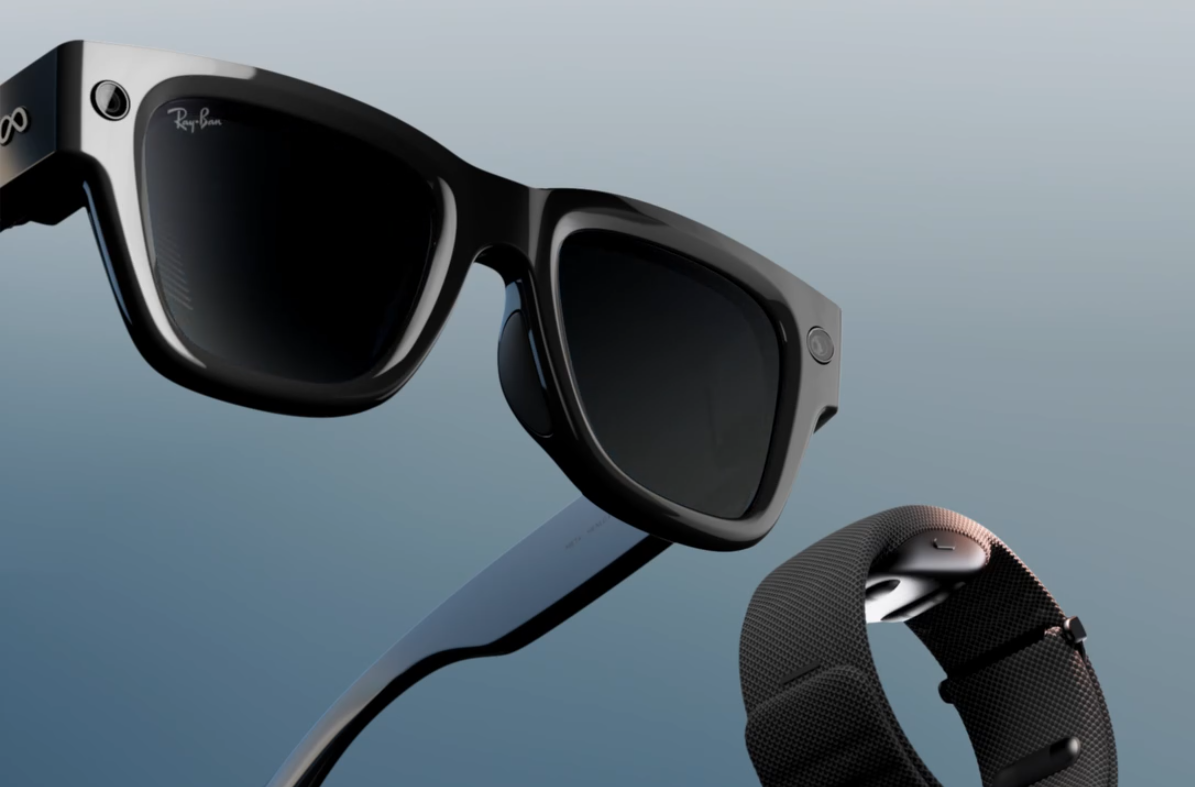
Meta Ray-Ban Display glasses are the point where Meta’s smart eyewear stopped being mainly a camera and audio product and started putting information directly in front of your eye.
Introduced in 2025, the glasses add a full-colour display positioned off to one side of the wearer’s view. They also ship with Meta Neural Band, an EMG wristband that reads subtle muscle activity and turns small hand movements into controls.
That makes them far more ambitious than the earlier Ray-Ban Meta glasses.
It also makes the question of whether you actually need them much harder.
The Display Is Designed for Glances, Not Movies
Meta is careful about the role of the in-lens display.
It is not intended to cover your entire field of view or turn everyday life into a giant floating computer desktop.
Instead, it is designed for short interactions.
You can glance at messages, translations, information from Meta AI or a preview of a photograph without pulling out your phone.
That narrower approach may be the right one.
A display that constantly blocks the world would make smart glasses exhausting. A display that appears only when useful has a better chance of fitting naturally into ordinary life.
Neural Band Is the Most Interesting Part
Each pair comes with Meta Neural Band.
The wristband uses electromyography to detect electrical signals associated with muscle activity. That allows subtle finger and hand movements to become commands.
The practical advantage is discretion.
Voice control works well until you are on a bus, in a meeting or standing beside strangers.
Touching the frame works, but that reminds everyone around you that you are operating a gadget.
A small hand gesture can feel much more natural.
Whether that control system becomes second nature will depend on software refinement and personal preference.
Cameras, Audio and AI Are Still Central
The glasses retain the core idea of Meta’s earlier smart eyewear.
Cameras can capture what you are seeing. Open-ear speakers provide audio. Microphones support calls and interaction with Meta AI.
The display adds another layer by letting the glasses show information rather than sending everything through audio.
That matters for translations, directions and short visual answers.
Audio-only smart glasses can tell you something. Display glasses can quietly show it.
Privacy Questions Do Not Disappear
Putting a camera into ordinary-looking glasses creates obvious social questions.
People around you may not immediately know whether the camera is recording.
Meta uses indicators and software controls, but good behaviour still depends on the wearer.
Smart glasses should be used with the same consideration you would apply when pointing a phone camera at somebody.
There are also broader questions about cloud processing, voice data and how much personal context users want an AI assistant to access.
Those are not reasons to dismiss the product, but they belong in the buying decision.
Availability and Price Keep Them Niche
Meta launched the Ray-Ban Display glasses in the US at a premium price, with demonstrations and sales initially focused on selected physical retail locations.
Availability can still vary by country, prescription requirements and retailer.
Before importing a pair, check whether setup, warranty support and Meta AI features work fully in your region.
Smart glasses are unusually dependent on software services, so grey-market hardware can be a poor bargain.
Who Should Buy Them?
Meta Ray-Ban Display makes sense for:
- early adopters
- people already comfortable with Ray-Ban Meta glasses
- users who rely heavily on Meta AI
- travellers interested in visual translation
- people who want hands-free messaging and information
- buyers fascinated by wearable interfaces
Pros
- Full-colour in-lens display
- Neural Band gesture control
- Camera, audio and AI in one wearable
- More discreet than constantly checking a phone
- Ray-Ban styling is less conspicuous than typical AR headsets
Cons
- Expensive
- Regional availability and support vary
- Privacy concerns remain
- Software ecosystem matters as much as hardware
- First-generation display products can age quickly
Final Verdict
Meta Ray-Ban Display is one of the clearest attempts yet to make augmented information feel like ordinary eyewear rather than a headset.
The best idea is not the display by itself.
It is the combination of a small glanceable screen with a wristband that lets you control it without constantly speaking or touching the frame.
That could become a normal way to interact with wearable computers.
In 2026, it is still a premium early-adopter product. Buy it because you actively want to live with the new interface, not because you need another way to receive notifications.